
Best Accounting Software for Short-Term Rentals (2026 Guide)
Compare the best accounting software for short-term rentals in 2026, from general ledgers to purpose-built trust accounting, and see where each fits.

Summary: Short-term rental accounting spans everything from basic income and expense tracking to reconciling OTA payouts and managing funds held on behalf of property owners. This guide compares the leading accounting software options for STR businesses in 2026, covering what each one does well and who it tends to fit best.
Short-term rental accounting looks simple from the outside: money comes in from Airbnb or Vrbo, expenses go out, and at the end of the month there’s a number left over. In practice, an STR property manager is juggling reservation-based revenue, owner distributions, vendor payments, and funds that legally belong to someone else, often across dozens of properties and several OTAs at once. General accounting software wasn’t built with that structure in mind, and the gap shows up fastest in reconciliation, not in the ledger itself.
This guide walks through the accounting software options STR operators actually use in 2026, what each one does well, and where the limits are for reservation-driven, multi-owner financial operations. For the operational side of running an STR business day to day, see Clearing’s beginner’s guide to Airbnb property management.

Why Accounting Software Matters for a Short-Term Rental Business
The case for using dedicated accounting software goes beyond having somewhere to record transactions. For an STR business specifically, it changes what’s actually possible day to day.
- Cash flow visibility. Reservation-based income arrives in pooled OTA payouts rather than a predictable monthly rent check, which makes it harder to see at a glance what’s actually available to spend or distribute to owners. Software that organizes income and expenses in one place makes that visibility possible without rebuilding a spreadsheet every week.
- Less manual work. Matching payments to bookings, categorizing expenses, and preparing month-end reports by hand takes real time as a portfolio grows. Automating that work frees up hours that would otherwise go into data entry rather than running the business.
- Tax readiness. Occupancy taxes, deductible expenses like maintenance and cleaning, and accurate income reporting all depend on clean records kept throughout the year rather than reconstructed at filing time. Software that categorizes transactions consistently turns tax season into pulling a report rather than piecing one together.
- Better decisions. Clean, current financial records make it possible to build a real budget, forecast upcoming expenses, and spot where a property or a portfolio is over or underperforming, rather than relying on a rough sense of how things are going.
Most of this is a bookkeeping problem, not a trust accounting one, and general accounting software can solve it reasonably well. Where things get more specific to STR is in the criteria below and in the reconciliation and trust accounting distinction covered later in this guide.
What to Look For in STR Accounting Software
Before comparing tools, it helps to know which features actually matter for a short-term rental business, as opposed to a standard small business.
- PMS and channel integration. The software should connect to the property management system in use, as well as booking channels and payment processors, so reservation, revenue, and payout data flow in automatically rather than requiring manual entry per reservation or an export from the PMS.
- Automation. Repetitive tasks like invoicing, expense categorization, and payout matching should run without manual entry per transaction. This is where most of the time savings in switching software actually comes from.
- Owner and property-level tracking. Every transaction needs to map to a specific property and, often, a specific owner. Generic categories aren’t enough once a portfolio crosses a handful of units.
- Occupancy tax handling. STR income carries tax obligations that vary by city and state. The software should support accurate tracking, even if it isn’t calculating the tax itself.
- Financial reporting. Profit and loss statements, cash flow reports, and owner statements need to be generated without manual rebuilding each month. For the fundamentals of what a clean chart of accounts and reporting structure looks like, see Clearing’s property management accounting guide.
- Bank reconciliation. The software should reconcile transactions against real bank activity, not just categorize what’s entered manually. This is a different function from bookkeeping: bookkeeping organizes the numbers, reconciliation verifies them against the bank. Getting the underlying account structure right matters too. See Clearing’s comparison of business bank accounts for short-term rentals for what to look for there.
- Scalability. A tool that works for five properties can start to break down at fifty, particularly around owner reporting and multi-entity structures.
- Data security. STR accounting software handles sensitive financial data alongside guest information, so encryption and other data protection measures matter as much as they would for any platform storing payment details.
- Team access control. Role-based access matters once bookkeepers, owners, and accountants all need visibility into different parts of the same books.
- Cost relative to portfolio size. Per-transaction or per-user pricing can scale unpredictably as a portfolio grows, so it’s worth modeling cost against unit count, not just the sticker price.
- Support and updates. Responsive customer support matters when a reconciliation issue needs resolving before month-end close, and a provider that ships regular updates is generally a sign of active investment in the product.
- Other practical factors. User reviews from other STR operators, mobile app quality, customization options, and whether a free trial is available are all worth checking before committing.
10 Best Accounting Software Options for Short-Term Rentals in 2026
QuickBooks Online
QuickBooks Online is one of the most widely used small business accounting platforms, and many STR operators start here because bookkeepers and accountants already know it well. It handles income and expense tracking, bank feeds, invoicing, and standard financial reports, and it integrates with a wide range of third-party apps.
For STR specifically, QuickBooks Online doesn’t natively separate owner funds from operating funds or track property-level detail without add-ons or a customized chart of accounts, so most managers pair it with a class or location structure to approximate property-level reporting.
Xero
Xero offers a comparable feature set to QuickBooks Online: live bank feeds, automated bookkeeping, bulk payments, and reporting on cash flow and profitability. Multi-currency support is available for managers with properties across borders, though it’s limited to Xero’s higher-tier plans. Xero is also praised for its streamlined interface.
Like QuickBooks Online, Xero is a general ledger. It tracks money moving in and out, but it doesn’t distinguish trust funds from operating funds on its own.
FreshBooks
FreshBooks is built primarily around invoicing and is a reasonable fit for smaller operators or those who self-manage a handful of properties. It covers expense tracking with receipt capture, project-level budgeting, and financial reports, with mobile apps for day-to-day use. Full double-entry accounting and financial statements are only available on FreshBooks’ higher plans, the entry-level tier is invoicing-focused with lighter reporting.
FreshBooks organizes work around clients and projects rather than properties, so an STR manager typically needs to set each property up as its own client or project to approximate portfolio tracking, similar to the workaround structure QuickBooks Online requires. FreshBooks is lighter-weight than QuickBooks Online or Xero, which makes it approachable, but that same simplicity means it’s a less natural fit as a portfolio grows past a few properties.
Clearing
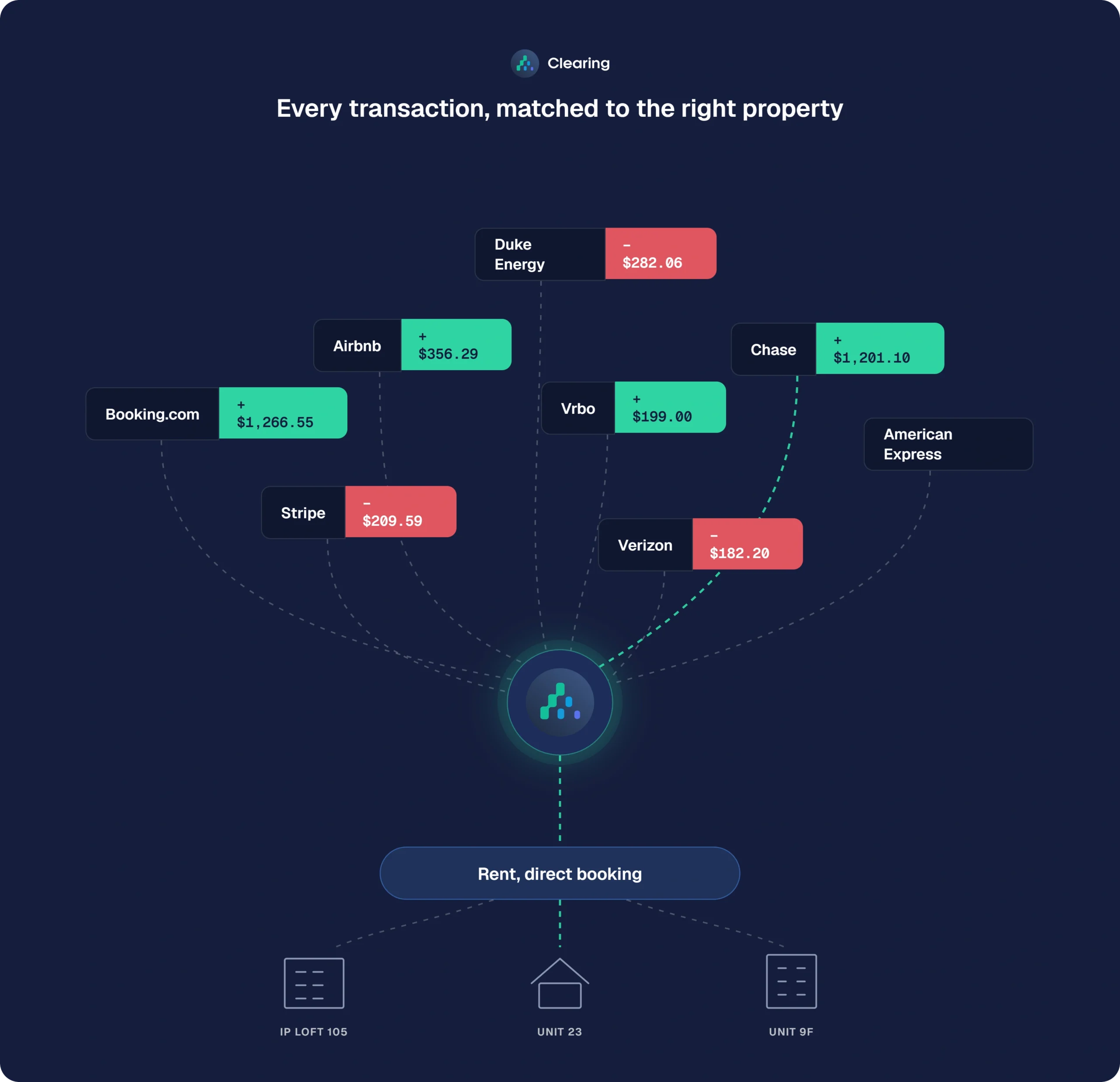
Clearing automates payout reconciliation from Airbnb, Vrbo, and other OTAs down to the transaction level, organizes bookkeeping by property and owner automatically, and keeps trust funds separated from operating funds so owner statements are accurate and reconciled without manual rebuilding each month. It also handles homeowner payments directly, so distributions go out without a separate manual payment step once the books are reconciled. That combination, reconciliation, trust accounting, and payments in a single system, is what most of the other tools on this list split across two or three separate products.
For managers who already use QuickBooks Online or Xero for the general ledger, Clearing sits alongside it rather than requiring a migration. It integrates into a manager’s existing property management system and, for firms that want to keep a general ledger in place, syncs with QuickBooks Online or Xero rather than requiring a full switch. It also works as a stand-alone system for managers who’d rather not run a separate general ledger at all, so the choice doesn’t have to be either-or, and there’s no rip-and-replace period where the books are in flux.
Clearing is one of a small number of tools built specifically for short-term rental trust accounting rather than adapted from general small business accounting, and it’s designed to scale from a handful of properties to a large multi-owner portfolio without a steep learning curve or a re-platforming project along the way.
Zoho Books
Zoho Books is a cloud-based accounting platform with automated transaction matching, categorization, and real-time reporting. It integrates with other Zoho products as well as external tools like PayPal and Stripe, and it stores receipts for each transaction, which simplifies recordkeeping for tax season and audits.
Zoho Books works well for operators already using other Zoho tools, but like the other general ledgers here, it treats an STR business the same as any other small business rather than accounting for reservation-based revenue or owner fund separation.
Sage Accounting
Sage Accounting offers unlimited invoicing, bank statement imports with automated reconciliation, and standard reporting including profit and loss, balance sheet, and cash flow. Budgeting tools and project-level cost tracking are available on Sage’s higher-tier plan rather than the base plan, so it’s worth confirming which tier includes them before choosing Sage based on those features.
Sage’s project tracking could be adapted to approximate property-level reporting, similar to the workaround structure QuickBooks Online requires, though it isn’t purpose-built for that. Reviews of Sage Accounting generally describe it as suited to very small businesses and sole traders looking for straightforward accounting, not a platform with a notably steeper learning curve than the alternatives on this list.
Topkey
Topkey is a financial automation platform, focused on expense management, bill pay, and vendor payments rather than general ledger accounting. It uses AI to auto-categorize receipts and bills by property and owner, splits trust versus operating funds, automates revenue recognition, and offers corporate cards, syncing the resulting data to a manager’s existing PMS and accounting software.
Topkey is designed to work alongside QuickBooks Online, Xero, or Sage Intacct rather than replace them, so it functions as an expense and accounts payable automation layer on top of a general ledger rather than a standalone accounting solution. Its trust accounting capabilities are newer than tools built with trust accounting as the primary product, worth weighing directly if audit-ready trust reconciliation is the main requirement rather than expense automation.
VRPlatform (VRTrust)
VRTrust is a full general ledger built specifically for short-term rental trust accounting, positioned as a standalone alternative to QuickBooks Online or Xero rather than something layered on top of them. It includes three-way reconciliation across bank ledger balance, bank statements, and owner balances, automated OTA payout breakdown, and revenue recognition options at check-in, check-out, booking, or split-month. Owner statements and an owner portal are built in, and it connects to bank accounts via Plaid in the US.
VRTrust can also sync with QuickBooks Online, Xero, or Sage Intacct for firms that want to keep a general ledger in place rather than replace it, similar to how Clearing sits alongside a general ledger. As of this writing, VRTrust doesn’t yet include built-in payment processing, so owner and vendor payments are handled outside the platform.
REI Hub
REI Hub is accounting software built specifically for rental property owners rather than general small businesses, with property-based accounting that works across single-family, multi-family, and short-term rental portfolios. It connects bank, mortgage, and credit card accounts directly, and generates tax-ready Schedule E reports alongside standard P&L, cash flow, and balance sheet reports.
REI Hub’s Airbnb and Vrbo payout statement importer is built for operators who host directly on those platforms. Managers booking through a property management system or channel manager won’t have that payout statement available and will need to use REI Hub’s manual transaction entry workflow instead, worth confirming before assuming automatic OTA import out of the box.
REI Hub’s rental-specific chart of accounts and preset transaction templates mean less setup work than a general ledger, though it’s built around single-owner rental accounting rather than the owner-distribution and trust-fund workflows a multi-owner STR management business needs.
Baselane
Baselane bundles banking and bookkeeping for landlords and rental property investors into one platform. It offers fee-free checking and savings accounts (banking services provided by its bank partner, Thread Bank, Member FDIC), automated collection of Airbnb, Vrbo, and Booking.com payouts directly into those accounts, and bookkeeping that auto-tags transactions to Schedule E categories by property as they happen, along with property-level P&L and cash flow reporting.
Baselane’s strength is combining banking and books in one login, which reduces reconciliation work for smaller portfolios. Larger STR operations managing owner funds across multiple properties will still need a dedicated trust accounting layer on top, since Baselane’s accounting is built around a single landlord’s own finances rather than funds held on behalf of separate property owners.
Bookkeeping vs. Trust Accounting: Why STR Software Needs Both
Bookkeeping and trust accounting are related but distinct functions. Bookkeeping organizes the numbers, income and expenses sorted into a coherent set of books. Reconciliation and trust accounting verify those numbers: confirming they match real bank activity, and keeping funds that belong to property owners separated from the manager’s own operating funds.
Most STR operators still need a general ledger like QuickBooks Online or Xero for standard accounting functions such as tax filing and high-level financial statements. What those platforms don’t do is reconcile hundreds of OTA payouts against bank deposits, generate owner statements automatically, or keep trust funds separated with an audit trail behind each transaction. Clearing is built around that second function specifically, treating trust accounting and reconciliation as the core product rather than a feature layered onto a general ledger after the fact. That means property managers get clean, reconciled books and accurate owner distributions without building that structure manually on top of a general ledger.
That distinction matters more every year as more states formalize trust accounting requirements for STR managers. For a full breakdown of what those requirements look like and how to implement them, see Clearing’s trust accounting guide. And for the mechanics of the reconciliation process itself, tying booking data to bank deposits and owner statements, see how to reconcile a trust account for STRs.


FAQ
What’s the difference between accounting software and trust accounting software for short-term rentals? General accounting software tracks income and expenses in a ledger. Trust accounting software specifically separates funds that belong to property owners from the manager’s own operating funds and verifies that separation against real bank activity, which most general ledgers don’t do without significant manual setup.
Can I use QuickBooks Online or Xero for my short-term rental business? Yes, both handle standard bookkeeping functions like expense tracking, invoicing, and financial reporting. Neither one natively separates owner trust funds from operating funds or reconciles OTA payouts at the transaction level, so many STR managers pair one of them with a purpose-built trust accounting tool.
Do I need dedicated trust accounting software if I only manage a few properties? It depends on state requirements and how funds are structured. Some states require formal trust accounting for anyone holding client funds, regardless of portfolio size. Managers should confirm the specific requirements in their state before deciding.
Clearing is a Financial Technology Company, not a bank.