
Trust Accounting for Short-Term Rental Managers: The Complete Guide for 2026
A plain-English guide to trust accounting for short-term rental managers: what it is, why it's becoming a legal requirement, and how to set it up right.

Quick summary: Trust accounting is the practice of keeping owner funds separate from your operating funds and tracking every dollar by property and stakeholder. For short-term rental managers, that means separating trust and operating accounts, reconciling OTA payouts against reservations, and producing accurate owner statements. It’s increasingly a legal requirement, not just a best practice. This guide covers what trust accounting means for STR managers specifically, why it matters, how it works in practice, and the most common mistakes that create audit risk.
Most property managers didn’t get into vacation rentals because they love reconciliation. But if you manage properties on behalf of owners, trust accounting isn’t optional. It’s the mechanism that proves every dollar an owner is owed actually reaches them, on time and accurately, with a paper trail that holds up if anyone asks to see it.
The stakes are real. Commingled funds, missed distributions, and inaccurate owner statements don’t just strain relationships. In a growing number of states, they’re compliance violations with real consequences. This guide walks through what trust accounting actually means for short-term rental managers, why the requirements are tightening, how the mechanics work day to day, and where most operators go wrong.
What Trust Accounting Means for Short-Term Rental Managers
Trust accounting means holding money that belongs to someone else, in this case, property owners, in an account that’s kept legally and operationally separate from your own business funds. You’re the custodian of that money, not the owner of it, until it’s disbursed.
For traditional property management, this is relatively straightforward: rent comes in, the manager’s fee gets deducted, the rest goes to the owner. Short-term rental management is more complex, and that complexity is exactly why generic accounting tools struggle here.
A few things make STR trust accounting distinct:
Reservation-level money movement. A single owner’s revenue for a month might come from a dozen different reservations, each booked through a different channel, each with its own fees, taxes, and payout timing.
OTA payout bundling. Airbnb, Vrbo, and Booking.com don’t send you one clean payment per reservation. They batch payouts, net out their own fees and sometimes guest taxes, and settle on their own schedule. Untangling what belongs to which owner, for which stay, is where trust accounting gets hard
Multiple stakeholders per property. Beyond the owner, you may be tracking co-host splits, vendor payments for cleaning or maintenance, and your own management fee, all from the same pool of reservation revenue.
Trust versus operating separation. Owner funds sit in a trust account. Your management fees and business operating costs sit in a separate operating account. The two should never mix, and every dollar that moves from trust to operating needs a documented reason.
This is different from bookkeeping, and the distinction matters. Bookkeeping organizes the financial picture: categorizing transactions, tracking expenses, keeping the general ledger current. Reconciliation verifies that picture: confirming that what your books say matches what actually happened in the bank account and in the trust ledger. Trust accounting depends on both. You need clean books to know what’s owed, and you need reconciliation to prove it’s accurate.
How This Differs from Traditional Real Estate Trust Accounting
Most trust accounting guidance online is written for long-term rental and general real estate brokerage, where the underlying transactions are simpler: a tenant pays rent once a month, a security deposit sits untouched for the length of a lease, and a sale closes with a single, well-documented transfer of funds.
Short-term rental trust accounting inherits the same core principles, funds segregation, accurate record-keeping, timely disbursement, but layers reservation-level complexity on top. A single owner’s monthly trust balance might be the net result of 15 separate bookings, three different OTAs, varying fee structures, and guest taxes collected and remitted on different schedules. Generic real estate trust accounting guidance, and the software built around it, often doesn’t account for that volume and complexity. That gap is exactly why purpose-built STR trust accounting tools exist.
The Goals of STR Trust Accounting
Whatever the specific state requirements or software involved, trust accounting for short-term rentals is built around a small set of goals:
- Owner funds stay separate from operating funds at all times, with no exceptions for short-term cash flow needs
- Every dollar is traceable to a specific property, reservation, and stakeholder
- Distributions to owners are accurate, timely, and backed by verifiable records
- The business can withstand an audit or a dispute without reconstructing history from scratch
Everything else, the account structure, the reconciliation cadence, the software involved, exists to serve those four outcomes.
Trust Accounting vs. Cohosting
Not every STR manager operates under a full trust accounting model. Cohosting, where a manager takes a percentage of revenue rather than acting as a fiduciary holding the owner’s funds, is simpler to set up and avoids some licensing requirements. But it doesn’t scale the same way: as a portfolio grows, crosses state lines, or takes on higher-value properties, the licensing exemptions and informal revenue-split arrangements that work for a handful of properties often stop applying. Choosing between the two models depends on portfolio size, state requirements, and growth plans. For a full comparison, see our guide on transitioning from cohosting to trust accounting.
Why Trust Accounting Matters for STR Property Managers
The regulatory landscape is tightening
Trust accounting has historically been treated as a best practice in vacation rental management, something responsible operators did because it was the right way to run a business. That’s changing. More states are formalizing trust accounting requirements specifically for property managers, with defined rules on how funds must be segregated, how quickly disbursements must happen, and what records must be kept on hand for audit.
For an STR manager, this means trust accounting is shifting from “how we choose to operate” to “what the law requires.” The specific requirements vary by state, and if you operate across multiple states, that variation is itself a compliance challenge worth taking seriously.
Commingling funds is the core risk
Commingling, mixing owner funds with your own operating funds, is the single most common trust accounting violation. It can happen unintentionally: a manager uses trust funds to cover a short-term cash flow gap in the business, intending to pay it back before anyone notices. It rarely stays that simple. Once trust and operating funds are mixed, untangling exactly whose money is whose becomes difficult, and if an audit or a dispute arises, the manager bears the burden of proving the numbers.
Owner trust is a retention driver, not just a compliance issue
Property owners increasingly expect clear, accurate, timely financial reporting. An owner who gets a confusing statement, or worse, a wrong one, starts wondering what else might be off. Trust accounting done well is invisible: the owner just sees accurate numbers and timely payments. Done poorly, it becomes the reason an owner moves their property to a different manager.
Audit exposure is a real, if lower-frequency, event
Not every STR manager will face a formal audit. But the ones who do need their trust ledger, bank records, and owner statements to line up cleanly, on demand, often going back months or years. Building that audit trail after the fact, from scattered spreadsheets or an accounting setup that was never designed for reservation-level trust tracking, is far harder than maintaining it continuously.
Why Trust Accounting Builds Better Owner Relationships
Compliance is one reason to take trust accounting seriously. The relationship with property owners is another, and it’s often the more immediate one.
An owner’s confidence in a manager is built statement by statement. When the numbers are clear, the distribution arrives on schedule, and every fee or deduction traces back to something specific, the owner has no reason to look closer. When a statement is confusing, late, or wrong even once, the owner starts wondering what else might be off, and that question rarely stays limited to accounting.
Clean trust accounting shows up in the owner relationship in a few concrete ways:
Fewer disputes over money. A statement that traces every dollar back to a specific reservation gives the owner nothing to question. A statement that shows a lump sum with no supporting detail invites exactly the kind of back-and-forth that erodes trust.
Faster answers when an owner asks a question. “Why was my payout lower this month” is a common question. A manager with reservation-level trust records can answer it in minutes. A manager relying on manual spreadsheets may need days to reconstruct the answer, and the delay itself damages confidence.
A credibility signal during owner acquisition. Prospective owners, particularly those with multiple properties or existing relationships with other managers, increasingly ask how their money will be handled before signing on. Being able to describe a real trust accounting process, not a vague assurance, is a differentiator in that conversation.
Retention through portfolio growth or a sale. Owners who’ve experienced clean, dependable reporting are less likely to shop around, and clean historical records make it easier for a management company itself to demonstrate value if it’s ever raising capital or being acquired.
None of this requires new technology on its own. It requires trust accounting that’s accurate and legible, consistently, not just at tax time.

How Trust Accounting Works in Practice
Separate trust and operating accounts
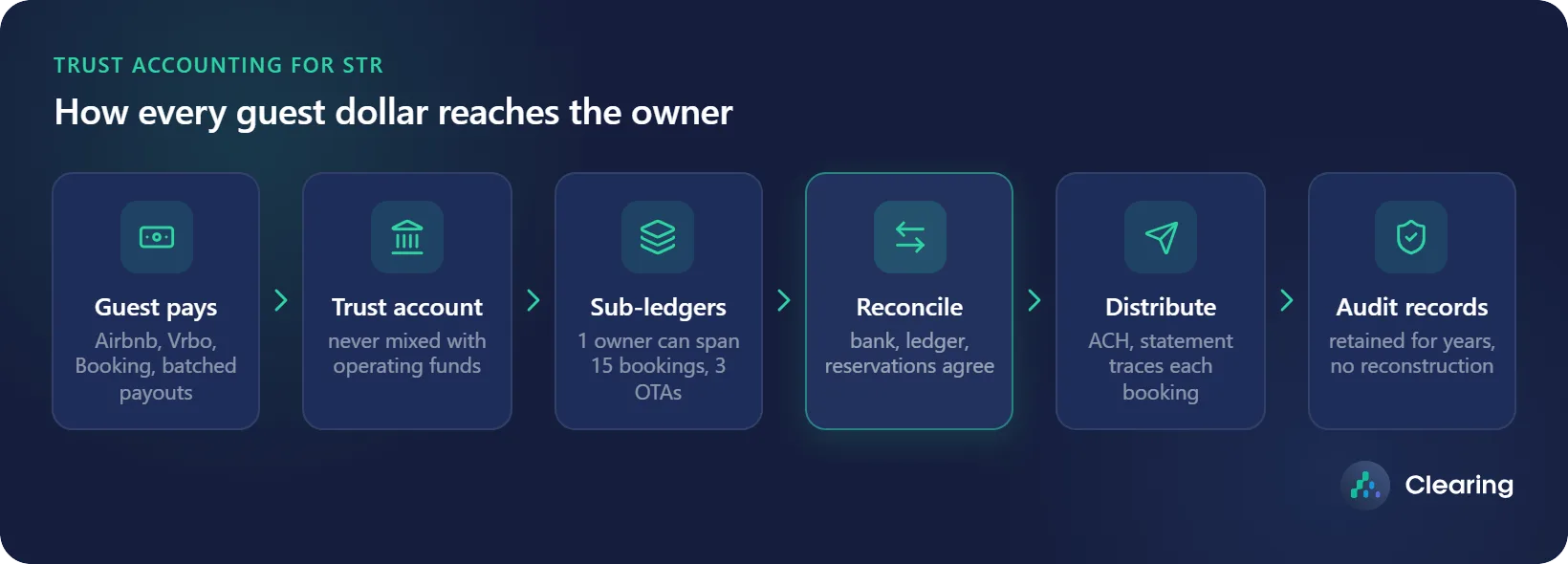
The foundation of trust accounting is a hard separation. Owner funds, including revenue collected from guests before it’s disbursed, live in a trust account. Your management fees, once earned and transferred out, live in your operating account. Some managers maintain one pooled trust account for all owners, with sub-ledger tracking for each; others maintain fully separate accounts per owner depending on state requirements and portfolio size.
Sub-ledgers by property and owner
Within the trust account, every dollar needs to be attributable to a specific property and a specific owner, even though the money physically sits in one pooled account. This sub-ledger tracking is what lets you answer, at any moment, exactly how much is owed to each owner and why.
Three-way reconciliation
This is where trust accounting gets operationally demanding. Three-way reconciliation means confirming that three separate records agree: the trust bank account balance, the trust ledger (what your books say each owner is owed), and the underlying reservation and payout data from your booking channels. When these three don’t match, something in the chain, a missed payout, a miscategorized fee, a timing gap, needs to be found and resolved before it compounds.
Owner distributions
Once revenue is reconciled and the management fee and any owner-approved expenses are accounted for, the remaining balance gets disbursed to the owner, typically via ACH, along with a statement showing the reservations, fees, and any deductions that produced that number. The distribution should be traceable back to specific bookings, not just a lump sum with no supporting detail.
A clear audit trail
Every step above should leave a paper trail: bank statements, the trust ledger, reservation-level detail, and disbursement records that can be pulled and reviewed without reconstruction. That’s the difference between trust accounting as a habit and trust accounting as a system.
Top Regulatory Considerations for STR Trust Accounting
Trust accounting rules aren’t uniform across the country, and that’s one of the more frustrating parts of managing STR properties in more than one state. While the specifics differ, most state-level trust accounting requirements address a similar set of questions:
How quickly must funds be deposited into trust? Some states specify a window, often a small number of business days, between receiving funds on an owner’s behalf and depositing them into a properly designated trust account. North Carolina’s Vacation Rental Act, for example, requires advance payments to be deposited into a trust account at a federally insured institution no later than three banking days after receipt, and caps pre-occupancy disbursement at fifty percent of total rent.
How quickly must disbursements happen? Once a distribution is owed to an owner, states often set expectations on how long a manager can hold it before paying out.
What records must be retained, and for how long? Trust ledgers, bank statements, and reservation-level backup are commonly required to be retained for a set number of years and produced on request.
Does the manager need a specific license or bond? In some states, handling trust funds as a property manager requires a real estate license, a separate trust account license, or a surety bond. North Carolina’s rules, for instance, apply specifically to landlords and real estate brokers handling vacation rental funds under its Vacation Rental Act.
Is commingling explicitly defined and penalized? Many states spell out commingling as a specific violation with defined consequences, separate from general accounting errors. North Carolina’s real estate commission runs random spot inspections of broker trust accounts specifically to catch commingling and mishandling before they compound.
Because these rules genuinely differ by state and change over time, this guide won’t attempt to summarize specific state statutes here. If you operate in multiple states, confirm the current requirements with your state’s real estate commission or a licensed attorney or accountant familiar with property management trust accounting in that jurisdiction before finalizing your setup.
How to Get Started: Steps to Implement Trust Accounting
If you’re building or auditing your own trust accounting setup, these are the foundational pieces to have in place:
- Open a dedicated trust account, separate from your operating account. This should be a distinct bank account, not a sub-account or a mental separation within one pool of funds.
- Confirm your state’s specific requirements. Deposit timelines, disbursement windows, and record retention rules vary. Know what applies to you before you need it.
- Build sub-ledger tracking by property and owner. Whether that’s a dedicated feature in your accounting software or a disciplined manual system, you need to be able to answer “how much does this owner have in trust right now” at any moment.
- Establish a reconciliation cadence, and stick to it. Continuous or weekly reconciliation catches problems early. Monthly reconciliation, done consistently, is far better than none. Reconciling only when something looks wrong is a system already in trouble.
- Standardize your owner statement format. Every distribution should come with a statement that traces back to specific reservations, fees, and any deductions, not just a total.
- Choose financial tools built for STR complexity, not retrofitted for it. General accounting software can be made to work with enough manual setup, but purpose-built tools handle OTA payout parsing, per-owner sub-ledgers, and trust and operating separation natively. See our guide on fintech tools for STR trust accounting for some good options.
- Document your process. If you’re ever audited, or if a new team member takes over trust accounting duties, a written process matters as much as the numbers themselves.
Common Trust Accounting Mistakes STR Managers Make
Treating trust accounting as a subset of general bookkeeping. A QuickBooks setup built for a typical small business, with a chart of accounts that doesn’t distinguish trust funds from operating funds, makes commingling easy to do by accident and hard to catch.
Reconciling monthly instead of continuously. Waiting until month-end to reconcile means errors have a month to compound and multiply before anyone notices. By the time a discrepancy surfaces, tracing it back to the original transaction can take hours.
Manually matching OTA payouts to reservations. Airbnb, Vrbo, and Booking.com payouts rarely map one-to-one to individual bookings. Manually parsing batched payouts against a reservation calendar is slow and error-prone, and it’s one of the most common places small discrepancies creep in undetected.
Disbursing before reconciliation is complete. Paying an owner based on an estimate, with the intention of correcting any discrepancy next cycle, undermines the entire point of trust accounting. Distributions should follow confirmed, reconciled numbers.
Inconsistent records across multiple owners or entities. As a portfolio grows past a handful of properties, especially with mixed management models like co-hosting or multi-entity ownership, informal tracking methods that worked at a small scale start producing real gaps.
No clear audit trail. If reconstructing “why does this owner’s statement show this number” requires digging through email threads, spreadsheet versions, and bank exports, the trust accounting system has already failed its main job.
How Clearing Approaches Trust Accounting
Clearing was built specifically for the trust accounting problem that short-term rental managers face: reservation-driven revenue, OTA payout complexity, and per-owner fund tracking that generic accounting tools weren’t designed to handle.
Clearing automates the reconciliation work at the center of trust accounting. Reservation data, bank activity, and your accounting records are reconciled continuously rather than at month-end, so discrepancies surface early instead of compounding. Per-owner balance tracking keeps every dollar attributed to the right property and owner, and owner distributions are generated from reconciled numbers, not estimates, with statements that trace back to the underlying reservations.
Clearing also keeps bookkeeping and reconciliation working together rather than as separate, disconnected steps: the books stay organized, and the numbers in them are continuously verified against what actually happened in the bank and in reservation data. That combination is what produces accurate, reconciled records without a manual reconstruction process at the end of the year.
Trust accounting done this way pays off in more than accurate books and a clear audit trail. It shows up the next time a prospective owner asks how their money is handled, the next time a portfolio is being valued for sale or acquisition, and the next time state requirements shift and a manager needs to show, not just claim, that funds have always been properly separated and tracked.
If you’re managing STR properties on behalf of owners and want to see how this works with your own portfolio’s structure, book a demo with Clearing to walk through it.


Frequently Asked Questions
What is trust accounting in property management? Trust accounting is the practice of holding client or owner funds in a legally and operationally separate account from a business’s own operating funds, with detailed records tracking exactly how much is owed to each party and why.
Do short-term rental managers legally need a trust account? Requirements vary by state, and a growing number of states now have formal trust accounting rules that apply to property managers, including those managing short-term rentals. Check the specific requirements in each state where you operate, since rules on fund segregation and disbursement timing differ.
What’s the difference between trust accounting and regular bookkeeping? Bookkeeping organizes financial transactions and keeps the general ledger current. Trust accounting adds a specific requirement on top of that: owner funds must be segregated from operating funds and tracked by property and stakeholder, with reconciliation proving the records are accurate.
What is commingling, and why is it a problem? Commingling is mixing owner trust funds with a business’s own operating funds. It’s the most common trust accounting violation, and it makes it difficult to prove whose money is whose if a dispute or audit arises.
Can I use QuickBooks for trust accounting? QuickBooks can support trust accounting with significant manual setup, including a custom chart of accounts and disciplined manual reconciliation, but it wasn’t purpose-built for reservation-level trust tracking or OTA payout reconciliation. Many STR managers pair it with a purpose-built tool or move to one built for the workflow. For a fuller look at what a complete STR bookkeeping system needs to handle, see our guide on vacation rental bookkeeping for professional property managers.
How often should trust accounts be reconciled? Continuously is ideal. Waiting until month-end allows errors to compound before they’re caught, and by then, tracing a discrepancy back to its source transaction takes significantly longer.
Does every property owner need a separate trust account? Not necessarily. Many managers use one pooled trust account with sub-ledger tracking for each owner, which is compliant in most states as long as the sub-ledger accurately reflects each owner’s balance. Some states or larger portfolios warrant fully separate accounts. Confirm what applies in your state.
What happens if a trust accounting audit finds a discrepancy? Consequences vary by state and by the size and cause of the discrepancy, ranging from a required correction and documentation to more serious licensing or legal consequences for pattern violations like ongoing commingling. This is exactly why continuous reconciliation and clean records matter well before an audit happens, not after.
Clearing is a Financial Technology Company, not a bank.