Game over for spreadsheets: how FunStay Homes cut accounting time by 70%
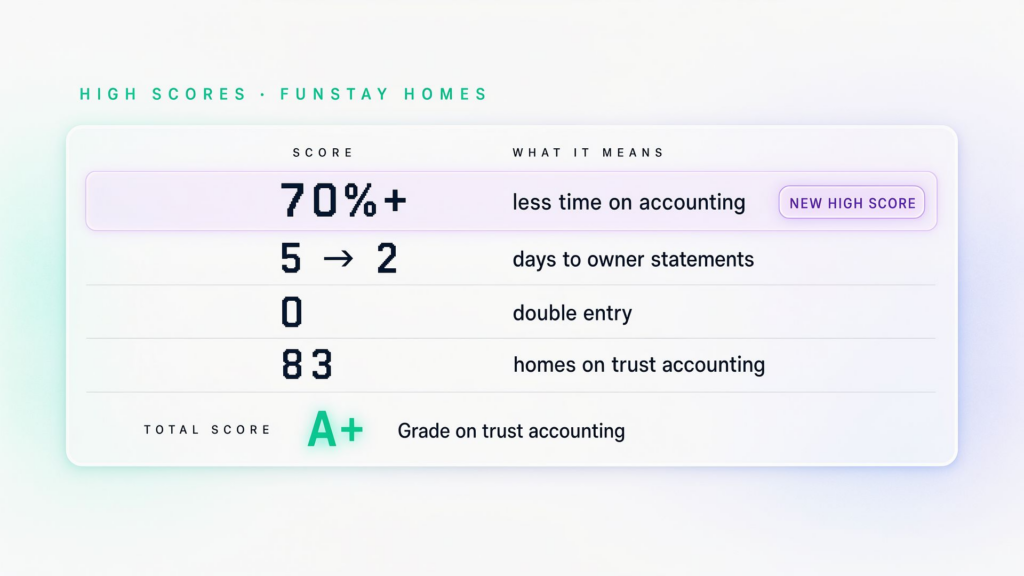
Here's how Mike Chen of FunStay Homes took control of his books, cut down time spent on accounting by 70%, and got owner statements out in two days instead of five.

- 70% less time on accounting
- 2 days for owner statements (down from 5!)
Mike Chen spent years as a professional accountant. Then he built a vacation rental business with 110 listings around Orlando, and his own books started running him. Here’s how he took them back, and got owner statements out in two days instead of five.
At a glance
| Company | FunStay Homes, a full-service vacation rental management company |
| Market | Orlando area, Florida |
| Portfolio | 110 listings, 83 of them on trust accounting |
| Founders | Mike Chen (Florida Realtor, Airbnb Superhost, former professional accountant) and Richard [surname TBC] |
| Challenge | A manual month-end close across disconnected systems, plus owner funds that needed airtight trust accounting |
| Results | More than 70% less time on accounting. Owner statements in 2 days, down from 5. Spreadsheets and double entry retired. A full year of books backfilled to January 1. |
Orlando runs on fun. The back office didn’t.
FunStay Homes is in the business of family vacations. Its homes around Orlando come with screened pools, themed game rooms and arcade cabinets, built for guests who came to play.
Mike bought his first vacation rental in Davenport in 2017 as an investment for his own family. Today he owns and operates more than 10 vacation homes himself, and FunStay manages 110 listings for owners across the Orlando area. He co-founded the company with Richard, a former real estate client who became a close friend. Both had struggled to find a property manager who cared about the homes and the owners.
“We felt we could do things differently and, most importantly, do it the right way, with an owner’s perspective,” Mike says. Airbnb has since recognized FunStay Homes among its Top 350 Professional Hosts in North America, in both 2025 and 2026.

The accountant whose books were running him
Mike knows his way around a ledger. That’s what made the problem so frustrating. “I knew the numbers, but I didn’t have a good system for keeping up with them,” he says. “I was constantly reconciling things, looking for missing information, and making sure everything was recorded correctly.”

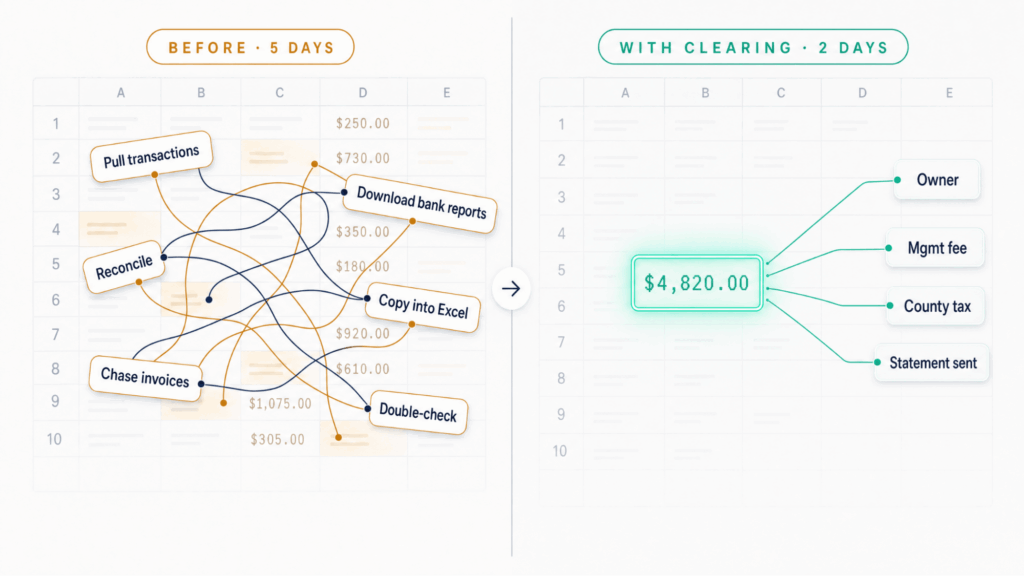
Month-end looked the same every time. Pull transactions from multiple systems. Download bank and payment reports. Reconcile everything. Move the numbers into Excel. Chase missing invoices. Double-check the math. Only then could he prepare owner statements. From the last checkout of the month to statements going out took about five days, and most of that time went to collecting and verifying data, not reviewing it.
Last December was the breaking point. Year-end close pushed everything else back, including FunStay’s first call with Clearing. “December was a mess,” Mike says. “Nothing was really connected, so I was constantly moving information from one place to another and double-checking everything.” The hours came from the one person who should have been growing the business.
Why trust accounting was non-negotiable
As a licensed Florida Realtor, Mike treats owner money as exactly that. “It’s not our money, and I take that responsibility very seriously.”
He had heard what happens when property managers don’t. During the pandemic, he spoke with managers who had treated client funds like company money. When reservations were cancelled and hundreds of thousands of dollars had to be refunded, the gap was exposed, and some of those companies went out of business. FunStay wasn’t holding client funds at the time, but the lesson stuck as the company grew.
“Trust accounting is a must. You have to know exactly where the money is and whose money it is.”
|
The 83-of-110 rule
FunStay runs 83 of its 110 listings through trust accounting in Clearing. Most of the homes left off are ones Mike owns personally. The line is simple: if you’re holding someone else’s money, it goes in trust.
“If you’re holding money that belongs to someone else, you need to have a very clear system for separating and tracking those funds. It becomes even more important as you grow and have dozens or hundreds of properties.” |
Why a former accountant chose software over spreadsheets
Mike is more qualified than most property managers to build his own system. He considered it. “I could have built a pretty complicated Excel system myself,” he says. “But no matter how good your Excel spreadsheet is, there’s always going to be a lot of manual work. As you grow, it just isn’t efficient.”
Hiring a bookkeeper would have eased the workload without fixing the root problem: transactions spread across systems that didn’t talk to each other. So FunStay compared trust accounting software options on five things: property management accounting, trust accounting, owner statements, reporting and automation. One question decided it. “Would this actually save us time and make the accounting more efficient as we continued to grow?”

Starting clean from January 1
Before going live, FunStay backfilled every transaction to January 1. For the first time, the whole year sat in one place instead of being pieced together from spreadsheets and exports.
That changed three conversations at once. Owners get accurate statements. FunStay’s CPA has a clean year to work from at tax time. And 1099s stopped being a scramble, because there’s a clear record of who was paid and how much.
FunStay’s PMS still runs operations. Clearing now keeps the books: bookings are matched to bank deposits, each owner’s rules are applied automatically, and statements go out from the same reconciled data. The spreadsheets and the PMS financial module are gone, and nothing gets entered twice.
“For me, the biggest thing is that I can finally look at the numbers and actually trust them,” Mike says. “I’m not wondering if something is missing or if I need to double-check everything in another spreadsheet.”
The scoreboard, six months in
- More than 70% less time spent on accounting.
- Owner statements in 2 days, down from 5. That’s 3 days back every month, roughly 36 days a year (calculated).
- Two tools retired: the spreadsheets and the PMS financial module. Zero double entry.
- A full, clean year of books for owners, the CPA and 1099s.
“It’s not just saving a few hours here and there,” Mike says. “It has taken a significant amount of manual work out of the process and made the whole thing much more efficient.” The biggest surprise was the size of it: “how much time we actually saved once everything was connected and we stopped doing double entry.”
Six months later, they’re Mike is still discovering new capabilities.
“One great feature we recently discovered is something we likely would have missed if we were still using Hostaway’s financial module. We had a chargeback, and Clearing flagged the discrepancy for us. In the past, we might have paid out the reservation without realizing there was an issue unless we specifically checked our Stripe account. Now, we can identify the discrepancy during month-end reconciliation and gather the necessary documentation to dispute the chargeback promptly. It’s a great example of how Clearing adds value beyond just trust accounting. We’re really happy to have made the switch!”
Bonus level: clean books help homes sell
Mike also sells vacation homes as investments, and buyers want real numbers. Clean, trust-accounted financials make that conversation easier. “I don’t think clean books automatically make a property worth more,” he says, “but they can make it easier for a buyer to understand the investment and feel comfortable with the numbers. And when an owner is ready to sell, having clean financials can make the whole process a lot smoother.”
What’s next
Mike is candid that no system is perfect. There are reporting features he’d still like to see, and he’s watching Clearing ship new ones. His advice to himself last December, mid-crunch, is short: “I wish we had made the switch sooner. I didn’t realize how much of that work could be eliminated with the right system.”
FAQ: trust accounting for vacation rental property managers
- What is vacation rental trust accounting?
Trust accounting means tracking money you hold for someone else, such as owner rental income, separately from your company’s money, with a clear record of whose funds are whose at all times. For property managers who collect guest payments on behalf of owners, it is how you prove every owner dollar is where it should be. - Which properties need trust accounting?
Any home where you hold funds that belong to another owner. FunStay Homes keeps 83 of its 110 listings on trust accounting and leaves off most of the homes its founder owns personally. - Can I switch mid-year?
Yes. FunStay Homes backfilled its books to January 1 before going live, so it had a complete year for owner statements, its CPA and 1099s. - Does Clearing replace my PMS?
No. Clearing is not a property management system. Your PMS runs operations, and Clearing keeps your books in order alongside it.