
Trust Liability vs. Cash: What Property Managers Need to Track (Free Template)
See what a trust liability report should show, how it should tie to cash in the bank, and how to check your own numbers. Includes a free Excel template.
Summary: A trust liability report shows who every dollar in your trust account is owed to: owners, management, tax authorities, and guests awaiting deposit returns. Cash in the bank should always match that total. When it doesn’t, the gap points to a specific, findable problem, not a mystery. This post breaks down each side of the report and includes a free Excel template you can use to check your own numbers.
What a Trust Liability Report Actually Shows
Every dollar sitting in a trust account belongs to someone. It might be an owner waiting on a payout, the management company’s earned commission, a tax authority owed occupancy tax, or a guest who paid for a stay that hasn’t happened yet. If you’re newer to how trust accounting works for short-term rentals, that’s a useful starting point before diving into the report itself.
A trust liability report lists out exactly who each dollar is owed to. For a typical short-term rental portfolio, that usually breaks into five categories:
- To owners: the sum of owner statement balances not yet paid out
- To management: commission and fees earned but not yet swept to the management company
- To tax: occupancy or lodging tax collected but not yet remitted
- Advance deposits: guest payments for future stays, not yet recognized as revenue
- Security deposits held: guest deposits held pending return or claim
Add those up and you get total liabilities: the full amount your trust account should be holding on behalf of everyone else.
A quick note: operating expenses, such as vendor bills or business overhead, don’t appear on this list. Those are paid out of the management company’s own operating account, not the trust account, so they’re not a trust liability in the first place. If an operating expense shows up here, that’s usually a sign it was booked to the wrong account.
Trust Liability vs. Cash: The Distinction That Matters
The liability side answers “who is owed money?” The cash side answers a different question: “what’s actually sitting in the bank?”
In a perfectly timed world, those two numbers would always match. In practice, timing creates small, temporary gaps. A booking might be recognized on your books before the guest’s payment actually settles in the bank. That gap has a name: cash in transit. It’s not an error, it’s a timing difference that should clear on its own once the deposit posts.
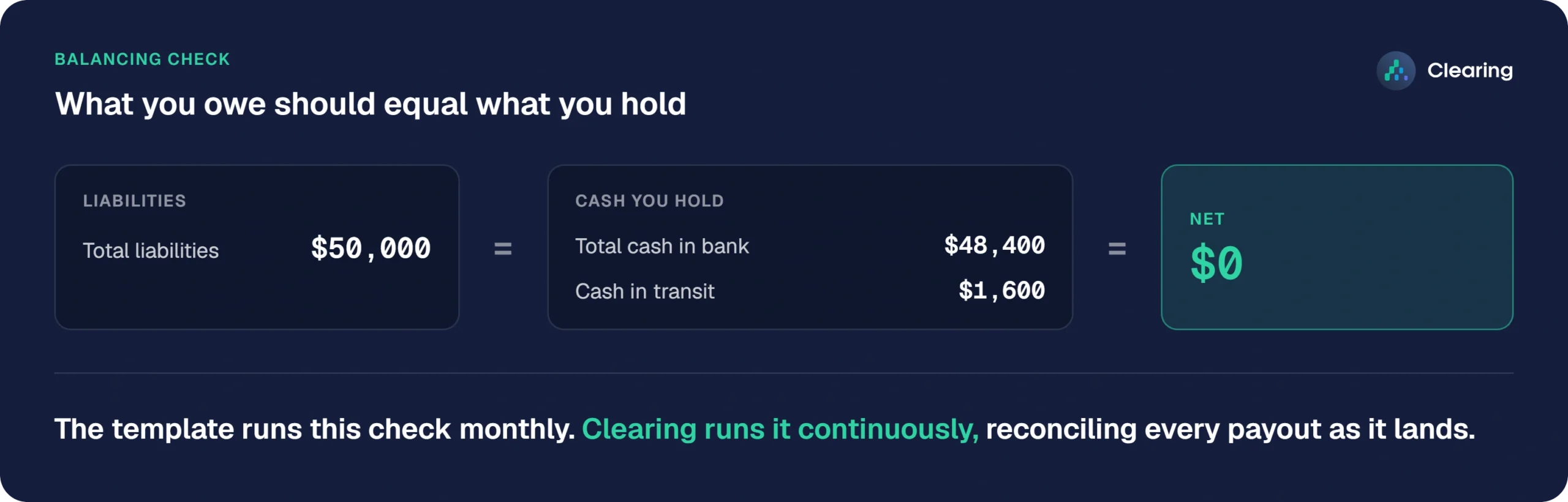
So the real comparison isn’t liabilities versus cash. It’s liabilities versus cash plus cash in transit:
Total Liabilities − Cash in Bank − Cash in Transit = Net
That number should always equal zero. When it does, every dollar in the account is accounted for and every liability is backed by real cash.
Bookkeeping Organizes This. Reconciliation Verifies It.
These two functions get blurred together, but they’re doing different jobs. Bookkeeping is what organizes the trust liability report in the first place: categorizing each transaction, attributing it to the right owner or stakeholder, and keeping the running totals current. Reconciliation is what verifies the result: confirming the liability total actually matches the bank account, deposit by deposit, transaction by transaction.
A trust liability report can look complete and still be wrong if it was never reconciled against the bank. The report tells you what your books say you owe. Reconciliation is what proves the bank agrees.
Reading the Balancing Check
If Net doesn’t equal zero, the direction of the gap tells you where to look first.
Liabilities greater than cash. This usually means there’s an unreconciled booking in the period, income that exists on the books but hasn’t been matched to an actual bank deposit yet. Go through your bookings for the period and check each one against the corresponding bank deposit until you find the gap.
Cash greater than liabilities. This is often the mirror image: a cancelled booking where funds were received but the booking was never added to a statement, so no liability was ever recorded for that cash.
Both sides reconciled, still off. If every booking checks out and the gap remains, the trust account itself may be over- or underfunded, for example from an incomplete prior transfer between accounts.
One Booking, Traced End to End
The clearest way to see liability and cash move together is to follow a single reservation through the process.
Say a guest books a $1,000 stay and pays in full at booking. The management agreement carries a 15% commission, and the local jurisdiction charges 5% occupancy tax. That $1,000 splits three ways:
- $150 to management (commission)
- $50 to tax (occupancy tax)
- $800 to the owner (remainder)
Add those allocations back up and you get $1,000, the same amount that hit the bank. Liability created and cash received match exactly, with a difference of zero.
If that booking is recognized on March 31 but the guest’s payment doesn’t settle until April 1, the $1,000 liability shows up on the March 31 report with no matching bank balance yet. It sits as cash in transit until the deposit posts, at which point it becomes ordinary cash in bank.
Where This Fits With Reconciliation
A trust liability report is one input into a full trust account reconciliation: it’s the liability side of the three-way match between bookings, bank activity, and what you owe each stakeholder. If you’re setting up that process for the first time, or want the full step-by-step, that guide walks through it in detail.
Cleaning up liability accounts is also a standard part of year-end trust accounting work: reviewing outstanding advances, security holds, and uncashed owner payments before they carry into the new year.
And if you’re newer to the underlying structure, our guide to how trust and operating accounts stay separate covers why this money can’t mix with your business’s own funds in the first place.
Get the Template
The free template lets you drop in your own numbers and see right away whether liability and cash actually balance. It includes an editable Liability Side and Cash Side breakdown, a formula-driven Balancing Check. Built for property managers doing this by hand today, whether you’re tracking five properties or fifty.
In Clearing, this same check runs automatically as the Trust Liability Report, folded into the monthly close instead of handled as a separate step.
Simply click the below link to access the template, make a copy of the file, and fill it in with your own information.
Clearing’s Trust Liability Report
FAQ
What is a trust liability report? A trust liability report lists every dollar a property manager holds in trust and who it’s owed to, typically broken into owners, management, tax, advance deposits, and security deposits held.
What’s the difference between trust liability and cash in the bank? Trust liability is what you owe stakeholders according to your books. Cash in the bank is what’s actually there. The two should match once cash in transit is factored in; a gap between them signals an unreconciled or missing transaction.
Why would liabilities and cash not match? The most common causes are an unreconciled booking (income recorded but not yet matched to a bank deposit), a cancelled booking where funds came in but no liability was recorded, or an issue with the trust account’s own funding.
Is a trust liability report the same as a trust account reconciliation? No. The liability report is one piece of a full reconciliation. Reconciliation verifies that the liability total, the bank balance, and the underlying bookings all agree with each other.


Clearing is a Financial Technology Company, not a bank.