
Commingling Funds: The Compliance Risk Every PM Should Understand
Commingling funds puts STR trust accounts at risk, even by accident. Learn what it is, how it happens, and how property managers keep funds separate.

Quick summary: Commingling funds means mixing money that belongs to someone else, typically an owner’s rent or reservation proceeds, with a property manager’s own operating cash. It’s one of the most common trust accounting violations in short-term rental management, and it usually happens by accident rather than intent. This guide explains how it happens, why regulators treat it seriously, and how to structure accounts so it doesn’t happen to you.
A guest pays for a five-night stay. The payout lands in the property manager’s general business account instead of a dedicated trust account. Nothing about that feels like fraud. It feels like a normal Tuesday. But the moment owner funds and business funds sit in the same account, without a clear, documented line between them, that property manager has commingled funds. And in most states, that’s a trust accounting violation regardless of intent.
For STR operators managing dozens or hundreds of units across multiple owners, this risk multiplies with every reservation, every OTA payout, and every account that doesn’t have a clearly defined purpose.
What Commingling Funds Means in Property Management
Commingling funds is the mixing of client or owner money with a property manager’s own operating funds, without a clear, auditable separation between the two.
In short-term rental management, this usually means guest payments, security deposits, or owner proceeds sitting in the same account as the money a PM uses to pay staff, vendors, or overhead. Even if every dollar is eventually accounted for correctly, the act of mixing the funds, without segregated tracking, is the violation. Regulators and state real estate commissions don’t require proof that money went missing. They require proof that it was kept separate.
This is why trust accounting exists as its own discipline, distinct from general bookkeeping. Bookkeeping organizes transactions after the fact. Trust accounting verifies, in real time, that funds belonging to each owner are held separately and can be traced back to their source at any point.
How Commingling Happens, Usually Without Anyone Intending It
Most commingling isn’t the result of bad actors. It’s the result of account structures that weren’t built for the complexity of reservation-driven money movement. A few common patterns:
A single operating account handles everything. Smaller PMs sometimes run guest payments, owner distributions, and business expenses through one account because opening and maintaining multiple bank accounts feels like overhead. The intent is simplicity. The result is a structure that can’t demonstrate separation if a regulator or an owner asks for it.
OTA payouts arrive as lump sums. Airbnb, Vrbo, and Booking.com typically batch multiple reservations into a single payout. Without a system that breaks that payout down by property and owner before it lands in an account, it’s easy for those funds to sit, temporarily undifferentiated, in whatever account receives them, often the operating account.
Timing gaps between collection and distribution. A PM collects a reservation payment weeks before the stay, but doesn’t owe the owner their share until after the guest checks out. In that gap, if the funds aren’t held in a dedicated trust account, they’re functionally sitting in the PM’s own working capital.
Manual reconciliation can’t keep pace. When reconciliation happens monthly or by spreadsheet, there’s no real-time visibility into whether a given dollar belongs to the business or to an owner. By the time anyone notices an issue, it may have compounded across dozens of reservations.
None of these are signs of dishonesty. They’re signs of account architecture and reconciliation cadence that haven’t caught up to the complexity of the business.
Why It’s a Compliance Violation, Not Just a Bookkeeping Slip
Most US states with real estate licensing requirements, and several with STR-specific trust account rules, require that funds held on behalf of a client be kept in a separate, identifiable trust or escrow account. Some states extend this requirement specifically to property managers handling rental income and security deposits, not just real estate brokers.
The standard regulators apply isn’t “was the owner harmed.” It’s whether the funds were properly segregated and traceable. A PM can make every owner whole and still be found in violation if trust funds were commingled with operating funds along the way. This is a structural requirement, not an outcomes-based one.
Because trust accounting rules vary by state, and this guide is intended as a general explainer rather than legal advice, property managers should confirm the specific requirements in the states where they operate before relying on any single account structure.
What Commingling Actually Costs
The consequences of commingling scale with how long it goes unaddressed and how a regulator or auditor discovers it.
- License exposure. In states that license property managers or require trust account compliance, commingling findings can result in fines, mandatory corrective action, or license suspension.
- Audit failure. If an owner, investor, or accountant requests a clean audit trail and the PM can’t produce one because funds were never segregated, that’s a failed audit, regardless of whether the underlying numbers were technically correct.
- Owner trust erosion. Owners who manage their investment properties through a PM are trusting that PM with their revenue. Even a technical, victimless commingling issue can damage that relationship once it’s disclosed or discovered.
- Operational drag. Untangling commingled funds after the fact, to reconstruct which dollars belonged to which owner, is slow, manual, and error-prone work that pulls a finance team away from everything else.
None of these outcomes require intent to defraud anyone. They follow from account structure alone.
How to Keep Funds Separated
The fix isn’t complicated in principle. It’s disciplined in practice.
- Use a dedicated trust account, separate from operating funds. Owner and manager funds should not sit in the same account used to pay business expenses.
- Maintain sub-ledgers for each owner or property. A single trust account can hold funds for multiple owners as long as sub-ledger accounting tracks exactly how much of that account balance belongs to each one at any given moment.
- Break down OTA payouts at the reservation level, not the batch level. A lump-sum payout needs to be allocated to the correct property and owner before it’s treated as available funds, not after.
- Reconcile continuously, not every 6 months. The gap between when money moves and when it’s reconciled is exactly where commingling risk lives. Three-way reconciliation, matching bookings, bank activity, and the general ledger, closes that gap.
- Keep an audit trail that shows the money, not just the total. Being able to produce a running total isn’t the same as being able to trace a specific dollar back to a specific reservation and owner.
Where Clearing Fits
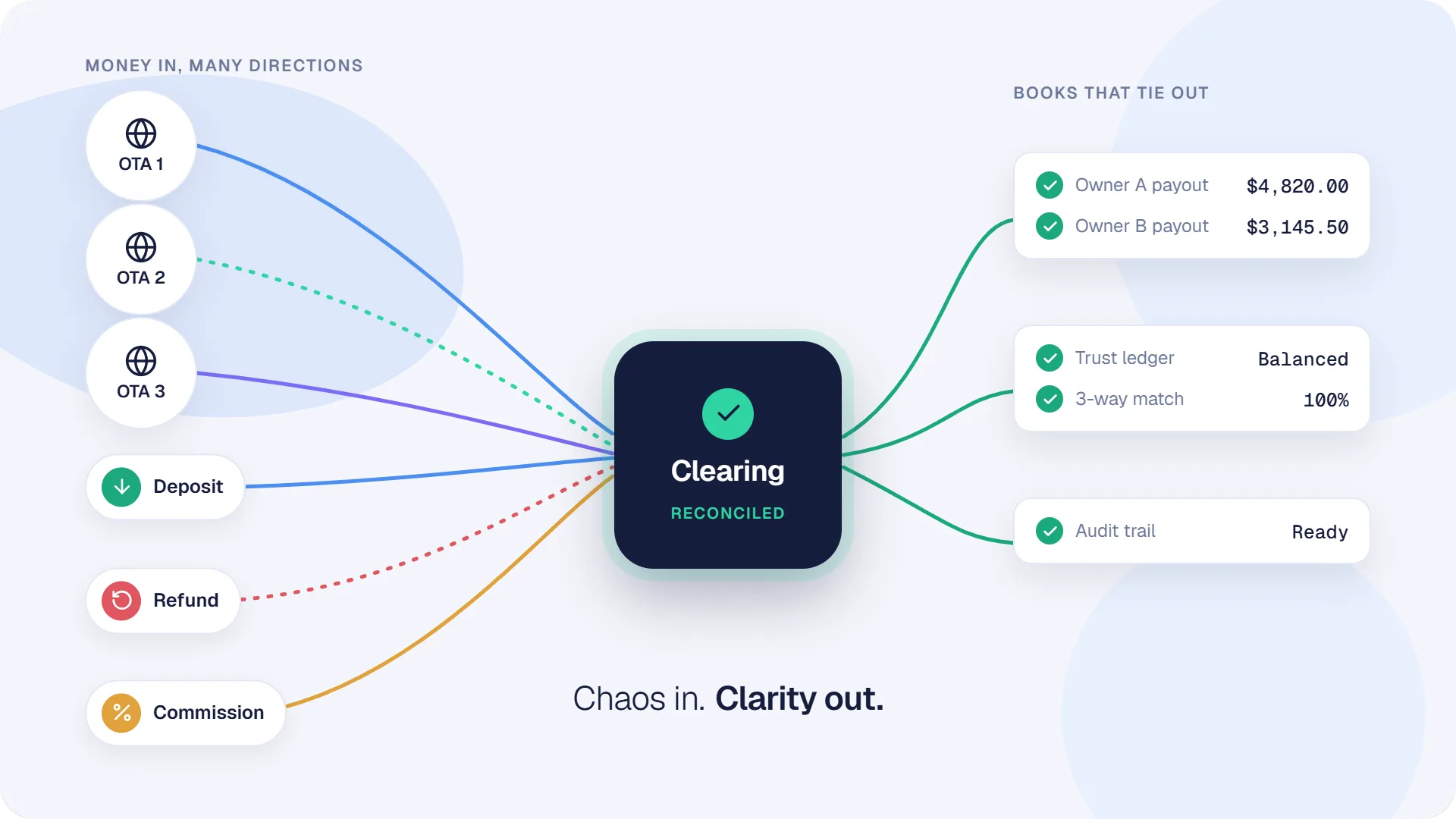
Clearing’s trust accounting is built around this exact separation. OTA payouts are broken down to the reservation level automatically, and reconciliation runs continuously against bookings and bank activity, so a PM always has an answer, not a reconstruction project, if an owner or a regulator asks where a dollar came from.
Your PMS runs operations. Clearing keeps your books in order, with owner and business funds segregated by structure from day one.
FAQ
Is commingling funds always illegal? In states that require trust or escrow accounts for property managers, yes, mixing client funds with operating funds violates trust accounting rules regardless of intent. Requirements vary by state, so confirm the specific rules where you operate.
Can commingling happen even if no money is missing? Yes. Regulators evaluate whether funds were properly segregated and traceable, not just whether the final numbers balanced. A PM can make every owner whole and still be found in violation.
What’s the difference between commingling and misappropriation? Commingling is mixing funds without proper separation, often unintentional. Misappropriation is using a client’s funds for an unauthorized purpose. Commingling can happen without misappropriation, but it creates the conditions where misappropriation becomes harder to detect.
How do OTA payouts contribute to commingling risk? Airbnb, Vrbo, and other platforms typically send lump-sum payouts covering multiple reservations. Without a system that allocates that payout to the correct property and owner immediately, the funds can sit undifferentiated in whatever account receives them.
Does a small property management company need a separate trust account? Size doesn’t change the requirement. If a PM holds funds on behalf of an owner, most states apply the same segregation standard regardless of portfolio size.


Clearing is a Financial Technology Company, not a bank.