
Top 5 Vacation Rental Accounting Software Tools for 2026
Compare top vacation rental accounting software for 2026, including Clearing, Buildium, and QuickBooks, and what STR-specific accounting actually requires.
Summary: Vacation rental accounting software ranges from general expense trackers to purpose-built trust accounting platforms, and the difference matters more than most property managers expect. This guide compares five widely used tools, Clyr, Clearing, Buildium, Baselane, and QuickBooks Online, on pricing, core functionality, and fit. It also covers the accounting requirements specific to short-term rentals, like trust fund separation and OTA payout reconciliation, that general-purpose tools were not built to handle.
Why Vacation Rental Accounting Is Its Own Category
Owning or managing vacation rental properties comes with a financial workload that looks nothing like a typical small business ledger. Every reservation touches multiple parties: the guest who pays, the OTA that collects the reservation income and remits a payout days or weeks later, the property owner who is owed a distribution, and the property manager who is owed a management fee out of the same transaction. A single booking can generate a dozen line items before the money settles into a bank account.
That complexity is why generic accounting software often falls short for STR operators. Tools built for freelancers or single-owner small businesses assume one bank account and one set of books. Vacation rental accounting has to reconcile reservation-driven revenue across OTA payouts, keep rental property bank accounts separate from operating funds, and produce owner statements clear enough to hold up to owner scrutiny and, in many states, trust accounting regulatory requirements.
Portfolio size changes the calculus too. A single-property host filing income once a year has different needs than a property management company distributing funds to dozens of owners every month. The tools below span that range, from expense capture at the small end to full trust accounting automation at the other.
At a Glance
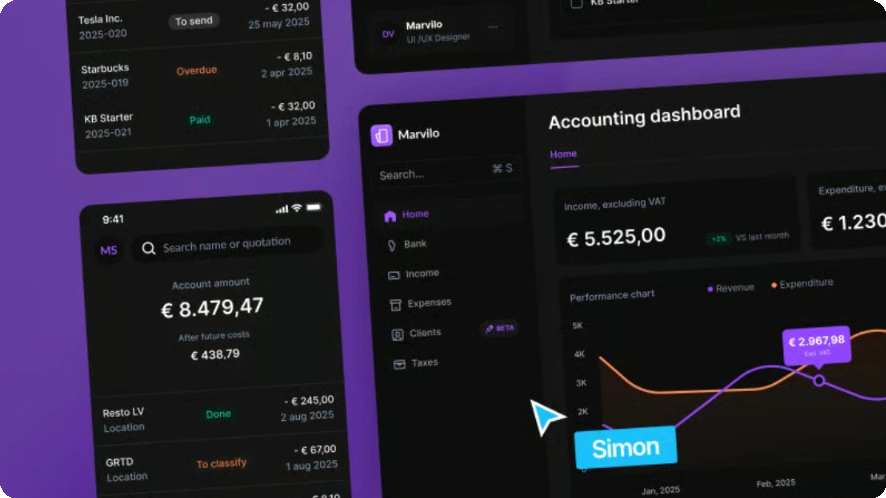
1. Clyr – Expense Management for Field-Based Teams

Clyr is an AI-powered expense and spend management platform built for teams with distributed, on-the-go expenses, including property management companies. It automates receipt capture and transaction matching so maintenance and operational costs get categorized without manual data entry.
Core functionality. Real-time receipt capture by SMS or email, automated transaction matching, property- and project-level budget tracking, and custom reporting. Clyr integrates with QuickBooks Online, Xero, Sage Intacct, NetSuite, and several property management platforms, including AppFolio and Buildium, so expense data can flow into whatever general ledger the business already runs
Pricing. Clyr does not publish a starting price. Its pricing page routes directly to a demo booking flow, so cost is quoted based on team size and transaction volume after a consultation.
Where it fits. Clyr solves the specific problem of getting maintenance and operational expenses categorized accurately without a manual receipt-chasing process. It is not a trust accounting or bookkeeping system in its own right. Property managers typically pair it with a general ledger or a dedicated trust accounting platform rather than running the full set of books through it.
2. Clearing – Trust Accounting and Reconciliation Built for STR
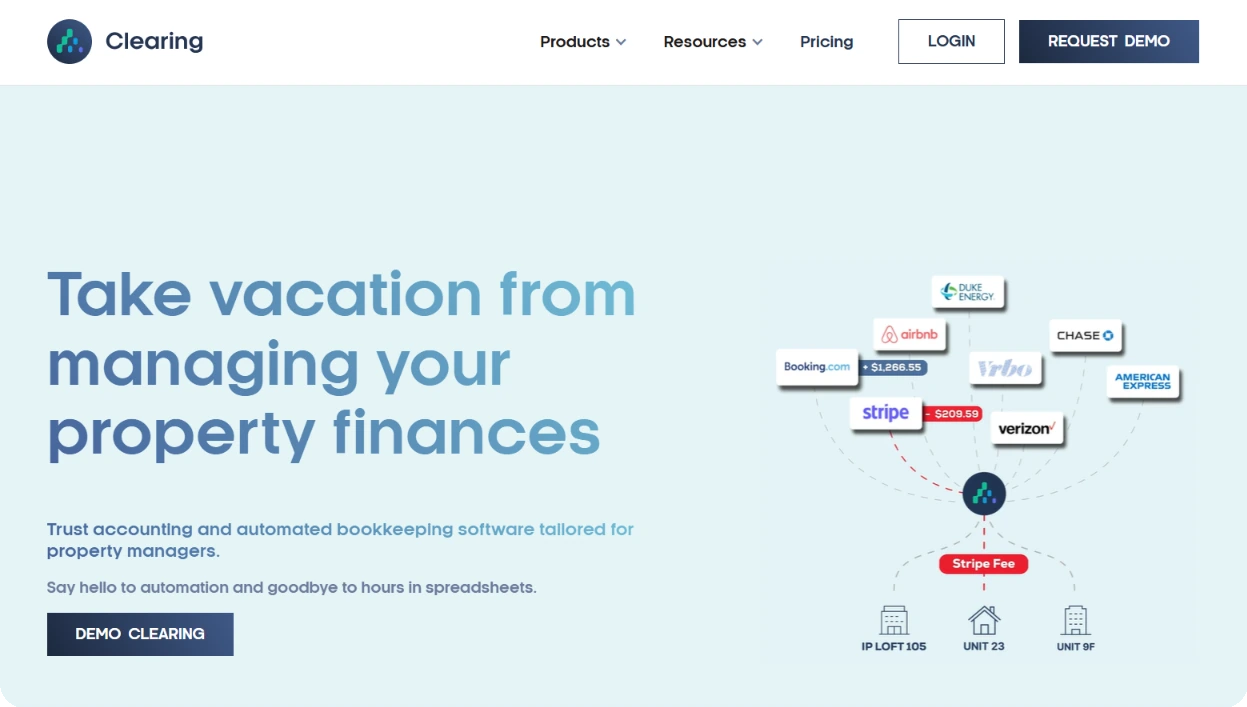
Clearing is an AI-powered trust accounting and bookkeeping automation platform built specifically for short-term rental property managers. Where general accounting tools require manual setup to separate owner funds from operating funds, Clearing’s trust account structure handles that separation by default.
Core functionality. Automated OTA payout reconciliation across the major booking channels, trust account management with owner-level fund separation, owner statement generation, and reconciled, accurate reporting. Clearing integrates with 15+ property management systems, including Guesty, Hostaway, Hostfully, Lodgify, OwnerRez, and Uplisting, plus payment processors and OTAs, so reservation and booking data flows in automatically rather than requiring manual entry into a separate system of records.
Pricing. Clearing’s published pricing is $10 per month per listing, with discounted pricing for larger operators. A one-time $199 implementation fee applies. Annual contracts get a 20% discount, and a 30-day money-back guarantee applies. Trust accounting, segregated owner and guest funds, and automated reconciliation are included in this single plan by default, not sold as a separate add-on tier.
Where it fits. Clearing is built for property managers who need trust accounting accuracy and reconciliation integrity as their core requirement, not just expense tracking on top of an existing system. It replaces the manual reconciliation work that would otherwise fall on a bookkeeper or accountant every month, matching reservation-level detail against OTA payout activity rather than treating each payout as a single lump deposit.
3. Buildium – Property Management with Built-In Accounting
Buildium is a property management platform with accounting functionality built in, aimed primarily at long-term residential portfolios, though it also serves community associations, student housing, and commercial properties. It bundles leasing, maintenance, resident communication, and financial reporting into one system.
Core functionality. General ledger accounting, online rent collection, automatic bank reconciliation with trust accounting rule reporting, an owner portal, and 1099 e-filing. Buildium’s trust accounting is built around long-term lease structures, security deposits and association funds reconciled against a standard operating account, rather than reservation-level OTA payout matching across multiple owners.
Pricing. Buildium’s Essential plan starts at $62 per month, Growth starts at $192 per month, and Premium starts at $400 per month, with each tier unlocking more features rather than a fixed unit cap. Per-transaction payment processing fees, bank account setup fees, and add-ons like tenant screening or eSignatures are priced separately on top of the base subscription. Custom pricing applies above 5,000 units or for community associations.
Where it fits. Buildium is a strong fit for long-term rental portfolios with standard lease structures and a smaller number of owners to report to. Its trust accounting reporting is built for lease-based funds like security deposits, not for reconciling reservation-driven OTA payouts across multiple owners. STR operators typically need to build that reconciliation manually within Buildium or supplement it with a dedicated trust accounting tool.
4. Baselane – Landlord Banking and Bookkeeping

Baselane is a financial technology platform combining landlord banking, automated bookkeeping, and rent collection for real estate investors, with dedicated features for short-term, mid-term, and long-term rental owners. It positions itself around removing the need for separate banking, bookkeeping, and rent collection tools.
Core functionality. Unlimited property-specific checking and savings accounts through Thread Bank, automated entity- and property-level income and expense tracking, real-time financial reports (net cash flow, rent roll, income statements), an accountant tax package with Schedule E reporting, and two-way sync with QuickBooks and Xero. The paid tier adds AI-based auto-tagging, auto-receipt matching, balance sheet reports, and cost segregation.
Pricing. Pricing. Baselane’s Core plan is free, $0 per month, with no monthly account fees or minimum balance requirements. The Smart plan is $20 per month and adds advanced automation, faster 2-day rent deposits, and shared team access. Standard fees apply for services like mailed checks ($2) and outbound wires ($15, waived above a $50,000 balance).
Where it fits. Baselane is built for individual landlords and real estate investors managing their own properties, with STR listed as one of its named customer segments. Its bookkeeping and banking tools are entity- and property-level, not structured around holding and reconciling funds on behalf of multiple third-party owners, so it doesn’t provide the multi-owner trust separation or OTA-specific payout matching that a property manager working on behalf of other owners needs.
5. Quickbooks – General Small Business Accounting
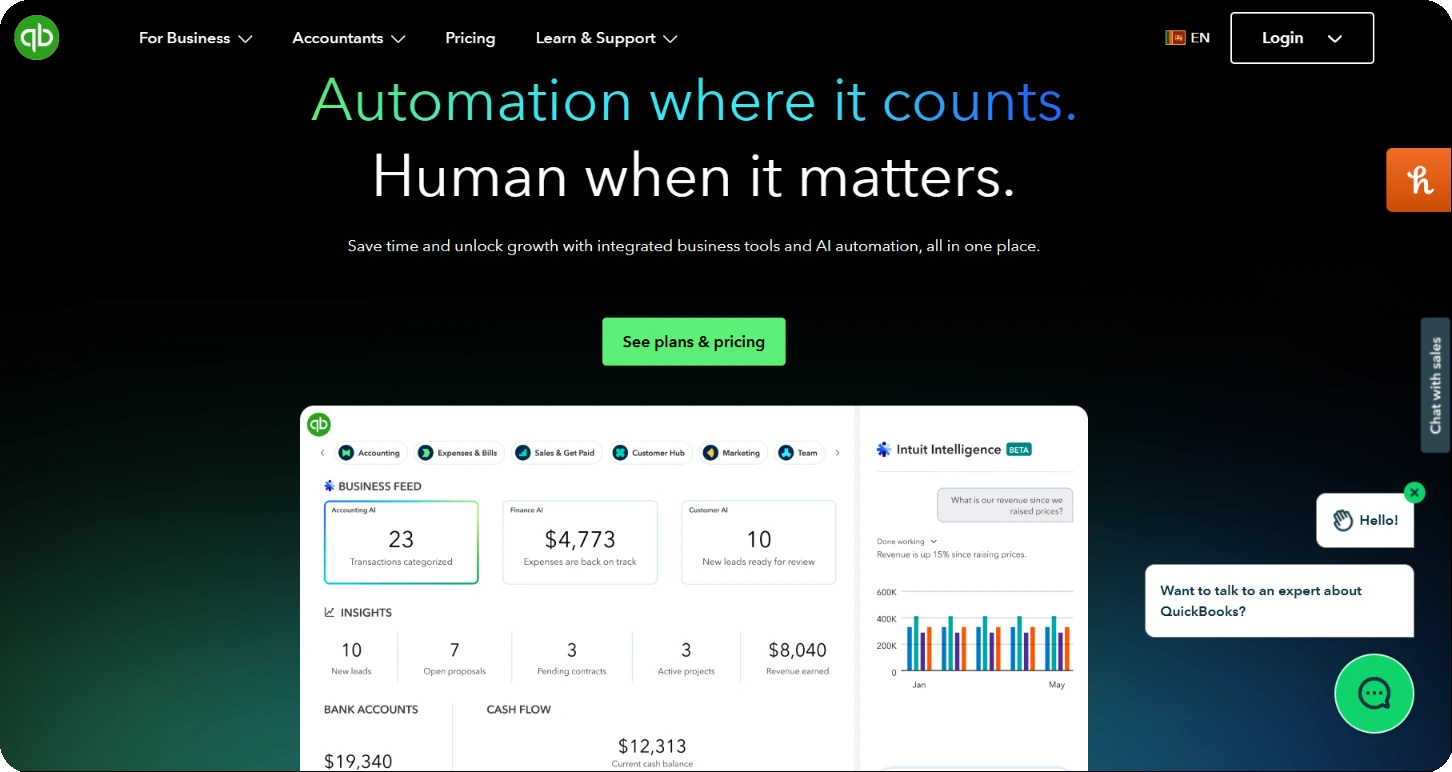
QuickBooks Online is the most widely used small business accounting platform in the United States, and many property managers start there because it’s what their accountant already knows and can support without additional training.
Core functionality. Double-entry accounting, invoicing, expense tracking, and standard financial reporting. Higher tiers add bill management, project profitability tracking, class and location tracking, and multi-currency support.
Pricing. QuickBooks Online’s current published pricing is Simple Start at $38 per month, Essentials at $85 per month, Plus at $140 per month, and Advanced at $340 per month for larger teams. User limits scale with tier, from 1 user on Simple Start to 25 on Advanced. Intuit has raised prices multiple times over the past two years, so it’s worth confirming current rates directly rather than relying on last year’s figure, and promotional discounts (commonly a percentage off for the first few months) can make the effective starting price lower than list price.
Where it fits. QuickBooks Online handles general ledger accounting well, but it has no native concept of per-owner trust separation or OTA payout matching. Property managers using it for STR accounting typically build a manual chart-of-accounts workaround to approximate trust separation, which is workable at small scale but becomes a growing reconciliation burden as the portfolio and owner count expand. For more on why STR bookkeeping differs from general small business bookkeeping in the first place, see the guide to short-term rental bookkeeping systems.
Essential Factors to Consider When Choosing Vacation Rental Accounting Software
Integration with Existing Systems
The software should connect directly with the property management system, channel managers, and bank accounts already in use. Manual data entry between disconnected systems is where most reconciliation errors originate, and the error rate compounds as the number of properties or owners grows. Before committing to a tool, it’s worth confirming exactly which property management systems it integrates with natively versus which require a manual export-import process.
Ease of Use and Learning Curve
Property managers are not always trained accountants, and the staff running day-to-day operations often aren’t either. Software that requires a steep learning curve to configure correctly adds risk, since a misconfigured trust separation or a missed reconciliation step is much harder to catch after the fact than to prevent up front. A tool with a clean interface and clear guardrails matters more here than in general business software, because the cost of a mistake is an owner’s money, not just an internal report.
Customer Support and Response Time
When a reconciliation doesn’t match or an owner statement looks off, response time matters more than it would for a minor software glitch elsewhere. Property managers should weigh the availability of live support during month-end close specifically, not just the presence of self-serve documentation. A knowledge base is fine for learning the software; it doesn’t help much when a discrepancy needs resolving before an owner statement goes out.
Whether the Tool Actually Handles STR-Specific Complexity
This is the factor most general accounting tools miss entirely, and it’s significant enough to break out on its own below.
Where STR-Specific Accounting Needs Diverge from General Tools
Most of the tools compared above were built for a broader market: freelancers, small businesses, or long-term residential property managers. None of that is a knock on them individually. It does mean three things specific to short-term rental accounting are worth checking carefully before choosing a platform, since a tool that’s excellent at general accounting can still leave real gaps here.
Trust fund separation. Owner funds and operating funds need to stay separate, both for accuracy and, in many states, for regulatory reasons. General ledger tools can be configured to approximate this with sub-accounts or class tracking, but the structure has to be built and maintained manually, and it’s easy for it to drift out of alignment over time. Commingling funds is a risk every property manager should understand clearly before assuming a general tool has this handled by default; it usually doesn’t, unless someone has deliberately built the separation in.
OTA payout reconciliation. A single Airbnb or Vrbo payout can represent dozens of individual reservations, each with its own guest, dates, fees, and taxes bundled into one deposit. Reconciling a payout back to its individual reservations line by line, rather than recording it as one lump sum, is a workflow that trust accounting platforms are built around from the ground up. General accounting tools generally treat that deposit as a single transaction, which leaves the underlying detail unreconciled unless someone manually breaks it apart.
Owner statements at scale. Producing a clear, accurate statement for one owner is straightforward in any accounting tool. Producing them consistently for dozens or hundreds of owners, each with a different management fee structure, different properties, and different reporting expectations, is where manual processes tend to break down. What starts as a half-day task at ten properties can become a multi-day scramble at a hundred, and the risk of a statement error rises right along with it.
Bank account structure. A dedicated rental property bank account separate from personal or general operating funds is the starting point for clean books, but it’s only the first layer. Trust accounting adds a second layer on top: separation by owner, not just by business, which most general accounting tools don’t structure for automatically.
State-by-state trust accounting requirements. Several states have specific rules governing how STR trust funds must be held and reported, and those rules vary meaningfully from one jurisdiction to the next. A tool with no concept of trust accounting at all leaves that compliance work entirely on the operator’s side, done manually and re-verified every reporting period.
None of this means a general tool can’t work for a small STR operation. A host with two or three properties and one or two owners, including themselves, can often manage fine with QuickBooks Online and a disciplined manual process. It means the workaround gets more expensive, in time spent and error risk, as the portfolio grows. That’s the trade-off worth weighing directly against the cost of a purpose-built platform, rather than assuming the cheaper general tool stays cheaper as the business scales.
Total Cost of Ownership: Beyond the Subscription Price
The published monthly price for any of these tools is only part of the real cost. A few things worth factoring in before comparing sticker prices directly:
- Payment processing and transaction fees. Several of the tools above list a base subscription price that doesn’t include ACH, card processing, or per-transaction fees, which can add a meaningful amount on top of the monthly rate depending on transaction volume.
- Time spent on manual workarounds. A general ledger tool priced lower than a trust accounting platform can still cost more in practice once the hours spent building and maintaining a manual trust-separation structure are counted.
- Add-on costs for payroll, live bookkeeping, or premium support. These are frequently priced separately from the base plan and can significantly change the real monthly bill.
- Cost of errors. A reconciliation mistake or a delayed owner statement carries a cost that doesn’t show up on a pricing page, whether that’s owner trust, staff time spent correcting it, or in some states, a compliance issue.
Comparing tools on subscription price alone tends to understate the total cost difference between a general accounting tool retrofitted for STR use and a platform built around trust accounting from the start.
How to Choose
Selecting vacation rental accounting software comes down to matching the tool to where the business actually is today, not where it started. A single-property host with straightforward expenses may only need Clyr for expense capture or QuickBooks Online for general bookkeeping. A growing property management company handling trust accounting across dozens of owners is solving a fundamentally different problem, one that general ledger tools weren’t built to solve without significant manual workarounds layered on top.
The right choice ultimately depends on portfolio size, owner count, and how much of the reconciliation and trust accounting workload the business wants to keep running manually versus automate. Clean books also make year-end income reporting and a readable balance sheet far less painful to produce, regardless of which platform generates them. For a deeper look at tools scoped specifically to trust accounting rather than general vacation rental bookkeeping, see the comparison of STR trust accounting software.
Choosing Clearing
Property managers who make the switch to Clearing are usually the ones who’ve already felt the cost of the manual workaround firsthand: hours spent each month matching OTA payouts back to individual reservations, owner statements that take longer to produce as the portfolio grows, or a nagging uncertainty about whether trust funds and operating funds are actually staying separate. Clearing is built to remove that manual step rather than add another dashboard on top of it.
CtxBnb, a short-term rental property manager, made that switch directly. Founder Laura Wooly described the shift this way: “Clearing’s platform has revolutionized the way we handle our finances. The ability to manage all aspects of our rental properties, from STRs to LTRs and even our personal finances, in one system has been a game-changer. We now have a clear and complete financial picture, which is invaluable for our business.”
That kind of outcome tends to show up fastest for property managers juggling multiple owners, mixed STR and long-term portfolios, or a reconciliation process that’s outgrown what a spreadsheet or general ledger workaround can reliably handle.


Frequently Asked Questions
Is QuickBooks Online enough for vacation rental accounting? QuickBooks Online can handle general bookkeeping, but it has no built-in concept of trust fund separation or OTA payout reconciliation. Property managers with a small number of properties sometimes make it work with a manual chart-of-accounts structure. As owner count grows, that manual workaround typically becomes the main source of reconciliation errors.
What’s the difference between bookkeeping and trust accounting for vacation rentals? Bookkeeping organizes financial transactions: income, expenses, and records. Trust accounting verifies that owner funds are correctly separated, reconciled against actual reservation activity, and never commingled with operating funds. Both are necessary for a property manager, and they solve different problems, not the same one from two angles. The distinction carries over from general real estate trust accounting; STR simply adds OTA payout complexity on top of it.
Do I need separate software for expense tracking and trust accounting? Not necessarily. Some property managers pair a dedicated expense tool like Clyr with a broader accounting system, while others use a single platform, like Clearing, that handles reconciliation, trust accounting, and reporting together. The right setup depends on how much of the financial workflow needs automation versus how much is already working fine manually.
Do I need trust accounting software if I only manage a few properties? It depends more on owner count than property count. A single owner managing their own two or three properties can often get by with general bookkeeping. Once a property manager is holding and distributing funds on behalf of other owners, even a small number of them, the trust separation requirement applies regardless of portfolio size, and the manual workaround gets harder to maintain correctly as more owners are added.
What should I look for beyond price? Integration with the property management system already in use, how the software handles OTA payout reconciliation specifically, whether it separates owner trust funds by default rather than requiring manual setup, and the quality of support available during month-end close, when issues are most likely to surface.
Clearing is a Financial Technology Company, not a bank.