QuickBooks for Airbnb: Where It Works and Where It Breaks
QuickBooks handles basic Airbnb bookkeeping well. See exactly where it holds up for STR managers, and where trust accounting needs start to break it down.
TL;DR: QuickBooks is a solid general ledger for a handful of Airbnb units, tracking income, expenses, and basic reporting without much friction. It starts to break down once a property manager holds owner funds across multiple properties, because QuickBooks was never built for trust accounting: yes, it organizes transactions, but it doesn’t segregate or verify owner money. This guide covers where that break point actually sits, the workarounds operators try first (class tracking, spreadsheets, sub-accounts), and why those workarounds run out of runway as owner fund volume grows.
Where QuickBooks Actually Works for Airbnb
For an owner-operator running one to three units, or a small host managing their own properties, QuickBooks Online does what it’s built to do. It categorizes income and expenses, connects to a bank account, and produces a profit and loss statement you can hand to an accountant at tax time.
It’s a genuinely capable tool for that scope. QuickBooks tracks per-property expenses like cleaning fees and maintenance, reconciles a single bank feed against transactions, and generates the reports most small hosts need for their own return. If your properties, your bank account, and your books all belong to the same person, QuickBooks is a reasonable choice and plenty of hosts run it without complaint.
The friction shows up at a specific point: the moment you’re managing money that belongs to someone else.
Where It Starts to Break: Managing Other People’s Money
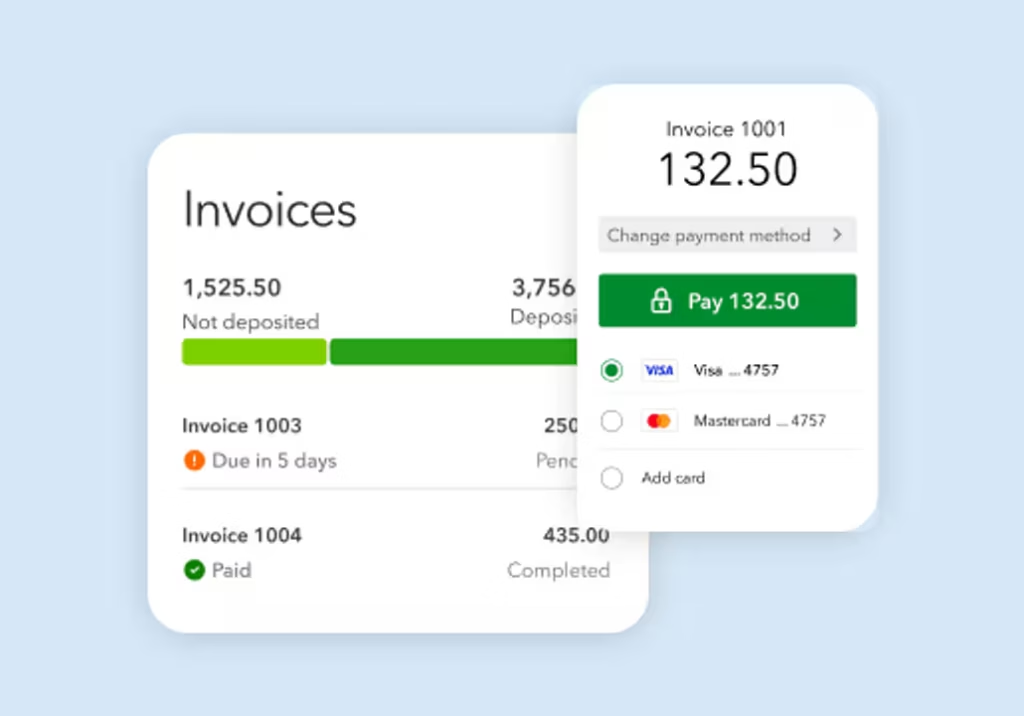
Short-term rental property managers aren’t just tracking their own expenses. They’re collecting guest payments on behalf of property owners, deducting a management fee, paying vendors, and distributing the remainder back to each owner, on a schedule, with a statement that has to be right every time.
QuickBooks has no native concept of holding funds in trust for someone else. It has classes and sub-accounts you can bend into an approximation of per-owner tracking, but nothing that segregates owner money from operating cash, flags a shortfall before it becomes a problem, or produces the kind of three-way reconciliation (bookings, bank activity, and owner balances) that trust accounting actually requires.
This is the same reason many states have specific rules around how property managers must hold and account for client funds. QuickBooks doesn’t know which dollars in the bank belong to which owner. A property manager using it for trust purposes has to build and maintain that logic manually, in spreadsheets, in memory, or in workarounds that don’t scale.
The Real Distinction: Bookkeeping vs. Trust Accounting
It’s worth being precise about what QuickBooks does and doesn’t do, because the two get conflated constantly.
Bookkeeping organizes. It categorizes transactions, tracks expenses against income, and produces the reports an accountant needs. QuickBooks is genuinely good at this.
Trust accounting verifies. It confirms that every dollar collected on an owner’s behalf is accounted for, segregated from operating funds, and reconciled against bookings, bank deposits, and owner statements before a single payout goes out. That’s a different job, and QuickBooks was never designed to do it.
Where Reservation-Driven Money Gets Messy
QuickBooks was designed for businesses with predictable, recurring transactions. Short-term rental income doesn’t work that way. A single reservation touches multiple OTAs, splits across cleaning fees, taxes, and management commission, and can be modified, cancelled, or refunded after the fact.
Matching a batch payout from Airbnb or Vrbo back to the individual bookings inside it is manual work in QuickBooks. There’s no native understanding of a reservation as a unit, so property managers end up building spreadsheets alongside QuickBooks just to figure out which owner is owed what, and why a payout total doesn’t match the sum of the bookings it should represent.
This becomes a bigger problem the more units a manager takes on. At a small portfolio, spreadsheet workarounds are annoying but survivable. As the portfolio grows, the manual reconciliation load tends to grow faster than the team supporting it, and that’s when errors start reaching owner statements.
Consider a manager running 30 units across two OTAs. A single weekly Airbnb payout might bundle 40 reservations, each with its own base rate, cleaning fee, occupancy tax, and cancellation adjustment, then net out a payment processing fee before it ever lands in the bank. QuickBooks sees one deposit. Matching that deposit back to 40 individual bookings, confirming each owner’s share is correct, and catching the one reservation that got refunded after checkout, is work QuickBooks has no mechanism to do on its own. Someone has to do it by hand, every payout, every week.
Common Workarounds, and Their Limits
Most property managers who outgrow plain QuickBooks try one of a few fixes before looking elsewhere:
- Class or location tracking to approximate per-owner segregation. This helps with reporting, but doesn’t actually separate funds in the bank, and doesn’t prevent commingling.
- A spreadsheet layer for owner statements and payout tracking, run alongside QuickBooks. This works until reservation volume outpaces what one person can reconcile by hand.
- Sub-accounts per owner, which multiplies the number of accounts to reconcile every month without solving the underlying reconciliation problem.
Each of these treats a structural gap as a workflow problem. They can extend how long QuickBooks stays workable, but they don’t change what QuickBooks fundamentally is: a general accounting tool, not a trust accounting system.
There’s also a cost most operators don’t see until later: every hour spent reconciling payouts by hand is an hour not spent on owner relationships, growth, or the parts of the business that actually need judgment. The workaround stack tends to hold until the team scales, an accountant turns over, or an owner asks a pointed question about a statement that doesn’t add up, and then the gap becomes visible all at once.
Our roundup of bookkeeping software options for short-term rentals covers how QuickBooks stacks up against other tools operators consider at this stage, including where each one still falls short of true trust accounting.
Where a Purpose-Built Layer Fits
This is where a platform like Clearing sits, not as a QuickBooks replacement, but as the trust accounting layer QuickBooks was never built to be. Clearing sits between the PMS and an operator’s downstream accounting system, automating the reconciliation of reservations, payouts, and owner distributions before the numbers ever need to touch a spreadsheet.
The split is clean: Clearing handles trust accounting, three-way reconciliation, and owner distributions, producing audit-ready books and owner statements you can stand behind without a manual review. QuickBooks still does what it does well, general bookkeeping and tax-ready reporting, fed by clean, categorized data instead of a payout total someone had to untangle by hand. Neither tool has to stretch into the other’s job, and you get financial history that’s portable if your PMS ever changes.
The Bottom Line
QuickBooks is not the wrong tool for Airbnb bookkeeping. It’s the wrong tool for holding and distributing other people’s money at scale. The line between those two jobs is exactly where most STR property managers start looking for something purpose-built, usually around the point where manual reconciliation starts costing more hours than it saves.
If you’re managing owner funds across multiple properties and starting to feel that gap, it’s worth seeing what trust accounting built for reservation-driven businesses actually looks like. Book a 15-minute demo to see how Clearing’s trust accounting fits alongside your existing stack.
FAQ
Can QuickBooks handle trust accounting for a property management business? Not natively. QuickBooks can approximate per-owner tracking using classes or sub-accounts, but it has no built-in mechanism to segregate owner funds from operating cash or verify that trust balances match what’s owed, which is the core function of trust accounting.
At what point does QuickBooks stop working for Airbnb property managers? There’s no fixed unit count where it breaks. The strain shows up once manual reconciliation between bookings, bank deposits, and owner statements takes longer than the team can sustainably keep up with, which tends to happen as owner fund volume and OTA complexity grow, not at any single fixed threshold.
Is QuickBooks the same as trust accounting software? No. QuickBooks is general-purpose bookkeeping software: it categorizes transactions and produces financial reports. Trust accounting software specifically segregates and reconciles funds held on behalf of others, a distinct function QuickBooks doesn’t perform.
Do property managers need to replace QuickBooks to add trust accounting? No. Trust accounting platforms like Clearing are typically designed to work alongside QuickBooks rather than replace it, handling reservation-level reconciliation and owner distributions, then passing clean data through for the bookkeeping QuickBooks already handles well. Book a demo with Clearing to see how it works.