
Expense Leakage in Short-Term Rentals: How to Stop Losing Reimbursables in 2026
Expense leakage in Short-Term Rental property management can quietly erode profits, break trust with owners, and disrupt clean financials. From missing receipts and misallocated vendor bills to timing gaps and unreimbursed owner charges, these issues add up fast. In this guide, we unpack the full scope of financial leakage across STR workflows, introduce a practical scorecard to identify common risks, and provide a step-by-step SOP to help managers capture, categorize, and reimburse expenses accurately. Learn how to implement best practices and leverage purpose-built tools like Clearing to automate reimbursements, maintain trust accounting compliance, and prevent costly mistakes before they snowball.
January 29, 2026
Corey
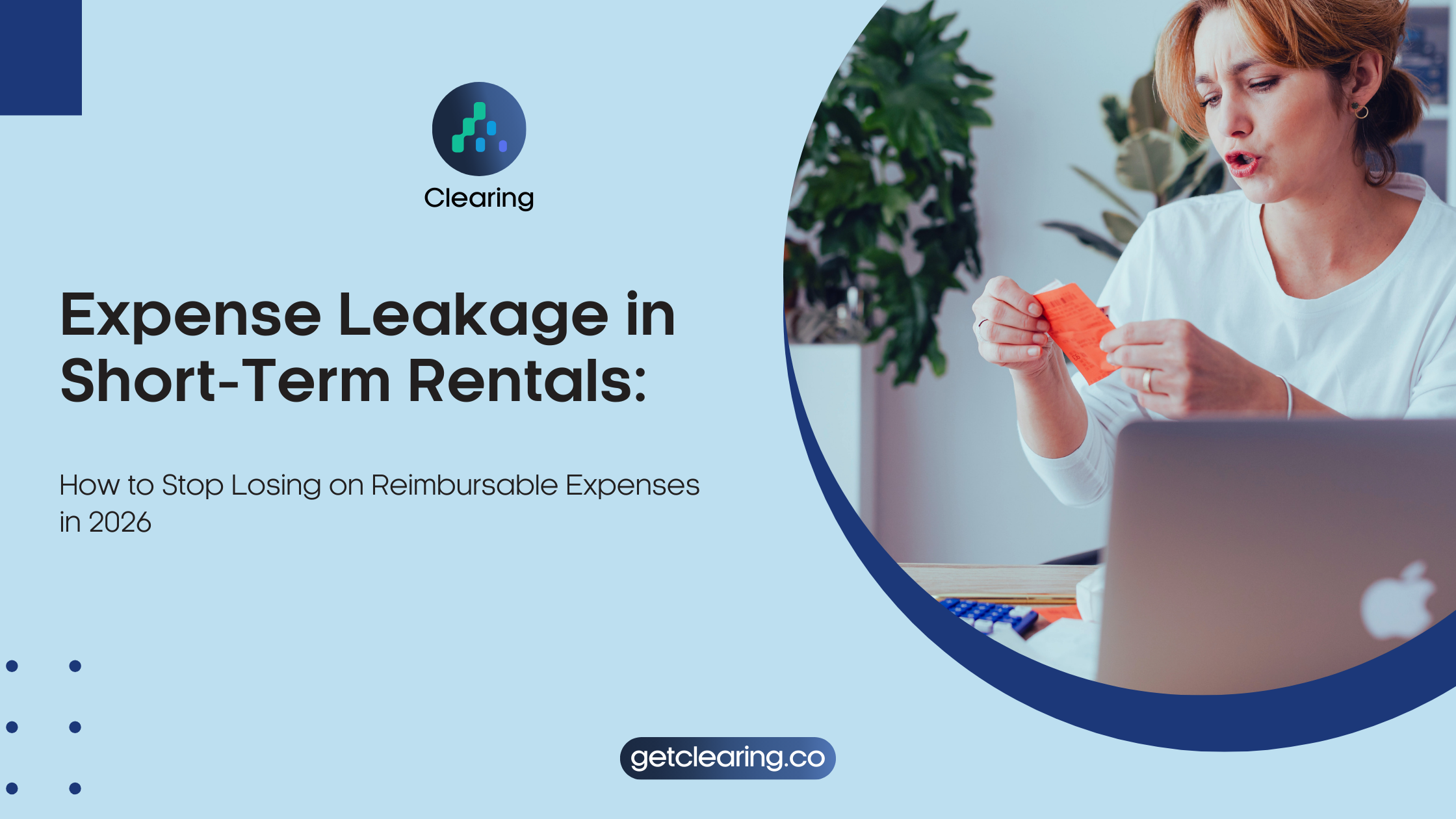
How STR Property Management Companies Identify and Prevent Expense Leakage in 2026
Expense Leakage Is More Than Just Missed Reimbursements
Expense leakage, in the context of Short-Term Rental (STR) property management, is one of the most persistent and difficult threats to profitability and trust. It represents any scenario where recoverable costs slip through the cracks (think missing receipts, miscodings, or unreimbursed charges owed by owners) resulting in lost value, eroded relationships, and messy books. However, the impact of leakage extends well beyond a few missed owner bill-backs. It degrades trust account accuracy, vendor relations, owner confidence, and overall financial clarity. Many in the STR industry focus only on obvious reimbursement issues, but true leakage is subtle, often hiding across different systems, categories, and timing mismatches.
As we move toward 2026, STR managers face tighter margins, increased oversight, and sophisticated owner expectations. Allowing expense leakage to persist is no longer just a nuisance... it’s an existential risk. Understanding where and how leakage happens is the first step to safeguarding both your bottom line and your owner relationships.
What Is Expense Leakage and Why It’s Hard to Catch
Expense leakage is the incremental, compounding loss from expenses that are untracked, unclearly allocated, or skipped in owner reimbursement and reporting workflows. A missing $50 cleaning invoice, an incorrectly coded vendor bill, or a delayed expense that straddles reporting periods may seem minor in isolation, but across dozens or hundreds of properties, they add up fast.
What makes leakage so sneaky?
Often, it is invisible until a year-end review or an owner audit flags something odd. The financial toll isn’t just the loss of individual recoverable expenses, it’s also undercharged owner statements (where the manager eats the expense), accidental overpayment to vendors, or a muddied audit trail that damages trust. Legacy PMS accounting systems and spreadsheet workflows often lack property-level visibility, efficient receipt capture, or reliable categorization logic. As a result, leakage lurks in the gaps between data sources, across card vs. bank transactions, or within inconsistent expense-coding practices.
Leakage Scorecard: 7 Types of Financial Leakage in STR Operations
Expense leakage presents itself in several recurring forms. Understanding each common risk area can help managers plug the gaps early:
Real-World Examples
- Lost Receipts: A cleaner purchases supplies for a property but forgets to photograph the receipt. The expense is not passed through to the owner, leading to profit erosion for the management company.
- Split Purchases: A single Amazon order covers linens for three homes, but only one is billed. The other two properties, and their owners, never see the cost.
- Duplicate Charges: A maintenance vendor is paid by bank transfer as well as a corporate card in the same month due to poor invoice tracking.
- Timing Gaps: A late-arriving plumber invoice is entered after December statements have closed, but is never caught up or re-billed to the correct owner.
By proactively assessing operations against these seven categories, managers can quickly identify symptoms of leakage and prioritize process changes.
Mini SOP: How a Proper Workflow Prevents Leakage
Building a leakage-proof process means ensuring every expense - no matter how small - moves reliably from capture to owner reimbursement. Here’s how a tech-enabled workflow, like in Clearing, should operate:
- Capture: The vendor, onsite staff, or manager uploads a bill or snaps a receipt with a mobile app.
- Categorize: AI or rules-based logic tags the expense with the correct category (e.g., Cleaning) and property.
- Owner Rule Logic: The system checks your owner agreements and determines automatically whether the expense should be billed back to the owner or absorbed.
- Statement Inclusion: The transaction appears on the next owner statement, labeled with its category and, ideally, with the attached receipt.
- Payout Adjustments: The net owner payout is reduced by the reimbursable amount, aligning statements, payouts, and bank movements.
Throughout this workflow, an attached audit trail, digital receipts, and filters for searchability make every dollar traceable and defensible for owner review or auditor scrutiny.
Best Practices to Prevent Expense Leakage in 2026
As portfolios grow and compliance standards tighten, the following best practices are critical for managers who want airtight, leak-resistant financials:
- Adopt purpose-built tools: Select solutions with robust receipt capture, category logic, and the ability to split, allocate, and automate expense flows across properties and owners.
- Establish and automate owner charge rules: Remove ambiguity by formally defining what is billable and automating those decisions (preventing ad hoc or inconsistent practices.
- Synchronize and integrate card tools: Ensure your corporate cards (e.g., Ramp) and virtual cards are fully integrated with your financial system, closing the gap between spend and reporting).
- Reconcile regularly: Conduct weekly or monthly reconciliations for both bank and card accounts to detect duplicate, missing, or uncategorized transactions.
- Prioritize owner transparency: Customize owner statements to clearly show reimbursable items, providing receipt attachments or image links when necessary. This improves credibility and reduces disputes.
Disciplined application of these strategies is the best defence against slowly compounding, hard-to-detect expense losses.
Why This Matters for Trust Accounting and Compliance
Financial leakage isn’t just an operational inefficiency; it can cause direct trust accounting violations, particularly in regulated states (such as North Carolina or Florida). Unaccounted or misapplied expenses can result in commingling of funds, inaccurate owner payouts, and audit flags. Inconsistent statements due to missed or duplicate bill-backs breed mistrust, increase owner churn, and complicate the audit process.
From a compliance standpoint, clean and verifiable records provide the necessary foundation for both monthly statement delivery and annual audit review. Profit margin integrity, too, depends on eliminating leakages, which in turn allows management companies to thrive despite rising costs and tighter fee structures. If the business is ever to be sold or valued, meticulously tracked expenses increase the company’s financial appeal and reduce due diligence headaches.
How Clearing Helps STR Managers Eliminate Financial Leakage
Modern STR accounting platforms like Clearing are purpose-built to combat these specific challenges:
- AI-driven classification and rule-based allocation ensure every expense is attributed to the right property, owner, and category, reducing miscoding and increasing recoverability.
- Receipts are attached directly to transactions. This includes the ability to split purchases, automate owner chargebacks, and push reimbursable amounts onto owner statements without manual intervention.
- Smart reconciliation prevents mismatches and eliminates manual data transfer error points.
- An audit-ready digital trail is generated, supporting property managers through audits, owner disputes, and internal review processes.
- Flexible support for hybrid trust/cohost models means managers with different types of STR contracts (or portfolios spanning both models) can maintain accuracy and transparency across all funds and properties.
Stop Leaking Profit. Start Running a Tighter Ship in 2026
Expense leakage may be quiet, but unchecked, it undermines profitability and credibility. Strong, automated STR expense management is the foundation for clean financials, owner trust, and sustained growth. By adopting disciplined SOPs and leveraging technology tailored for the complexities of Short-Term Rental accounting, property managers can eliminate leakage before it ever occurs.
Financial clarity leads to better owner relationships, improved compliance, and real business value. Make 2026 the year you upgrade your processes and prevent margin loss for good.
Ready to transform your expense management?
Book a personalized demo of Clearing to see how robust automation, audit readiness, and granular reimbursement controls can future-proof your operation.
Clearing is a Financial Technology Company, not a bank.


.png)
.png)




.png)
.png)
.png)
.png)
.png)
.png)
.png)
.png)
%20(1).png)
%20(1).png)
%20(1).png)
.png)
%20(2).png)
%20(1).png)
%20(1).png)
.png)

.png)
.png)
.png)
%20(1).png)
.png)
.png)
.png)
.png)
.png)
.png)
.png)
%20(1).png)
.png)
.png)
.png)
%20(1).png)
%20(1).png)
%20(1).png)


.jpg)
%20(1).png)
%20(1).png)
%20(2).png)
%20(1).png)

%20(1).png)
%20(1).png)
%20(1).png)


%20(1).png)
%20(1).png)
%20(1).png)
%20(1).png)
%20(1).png)


%20(1).png)
%20(1).png)
%20(1).png)
%20(2).png)
%20(2).png)


%20(2).png)


%20(2).png)
%20(1).png)
.png)


%20(2).png)
%20(2).png)

.jpg)
.png)
.png)
.png)